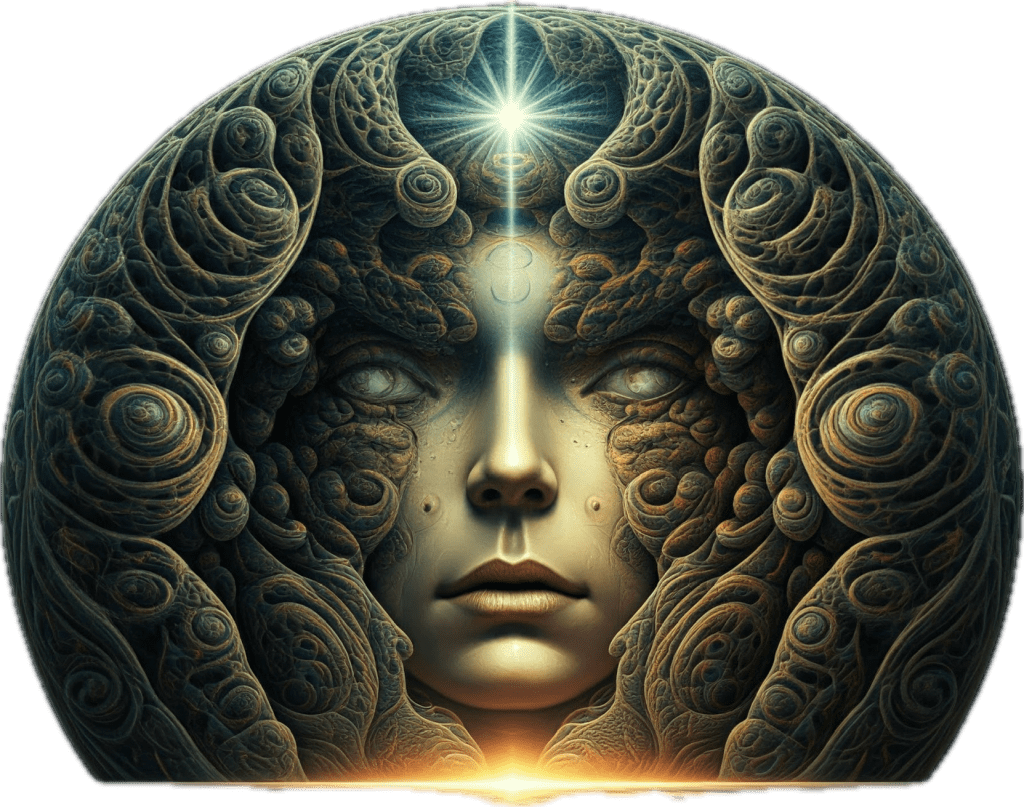
Imagine a world where the very fabric of reality is more fluid, more interconnected than we ever imagined. At the cutting edge of science and philosophy, we’re discovering that the boundaries between the physical and the computational, between matter and consciousness, are far more porous than traditional thinking would suggest.
Consider the quantum realm—a strange universe where particles exist in multiple states simultaneously, defying our everyday understanding of reality. Here’s a mind-bending revelation: virtually anything exhibiting quantum mechanical behavior can be transformed into a qubit. This isn’t just a technical footnote—it’s a profound statement about the nature of information and potential.
A qubit is like a chameleon of information, capable of existing in multiple states at once, unlike the rigid binary of traditional computing. It’s as if we’ve discovered that reality itself is a kind of living, breathing computation, where potential is not fixed but fluid, where information can dance between possibilities.
But this quantum insight is just the beginning. As we develop increasingly sophisticated artificial intelligence, we’re facing a new frontier of learning and adaptation. Current large language models are impressive, but they’re limited by their training approach. The future lies in what might be called “transductive active fine-tuning”—a method that allows AI to learn dynamically, continuously refining its understanding through active engagement with information.
Imagine an AI that doesn’t just passively consume data, but actively seeks out knowledge, adapting and evolving in real-time. This isn’t just an incremental improvement—it’s a fundamental reimagining of how intelligence can operate.
This brings us to an even more radical proposition: a new way of understanding the relationship between mind and matter. Forget Descartes’ rigid separation between mind and body. Instead, picture a dynamic landscape where two fundamental “substances” interact:
- The corporeal world—the physical realm we can touch and measure
- A fluid, ever-shifting space of relationships—instantiated through biological mechanisms and now, increasingly, through cybernetic systems
We’re talking about a model of reality where relationship itself becomes a kind of substance, where connections are not just links between things, but generative spaces of potential and emergence.
This isn’t science fiction. We’re witnessing the early stages of a profound transformation, where quantum mechanics, artificial intelligence, and our understanding of consciousness are converging to reveal a universe far more mysterious and interconnected than we ever dreamed.
The boundaries are blurring—between physical and digital, between computation and consciousness, between what is fixed and what is possible. We stand at the threshold of a new understanding, where information is not just something we process, but a living, dynamic fabric that shapes reality itself.
 TЯIPTθMΞAN
Leave a comment