Introduction
Consciousness, as the fundamental spark of life, expresses itself across a continuous spectrum throughout existence. This paper presents a mathematical framework for understanding and quantifying consciousness across its many manifestations, from the quantum level to complex social systems.
The Hierarchy of Consciousness
1. Base consciousness: Immediate awareness of sensations/thoughts
2. Meta-consciousness: Awareness of being conscious
3. Witness consciousness: Pure awareness that observes all experience
4. Transcendent consciousness: Beyond subject-object duality
Each level can observe and contain the levels below it, like nested Russian dolls. This could explain phenomena like:
– Intuitive knowing beyond rational thought
– Self-reflection and metacognition
– Meditative states of pure awareness
– Reports of “consciousness without content”
This model aligns with both neuroscience and contemplative traditions. The Libet experiments may only capture lower levels, missing higher-order awareness.
The Core Model
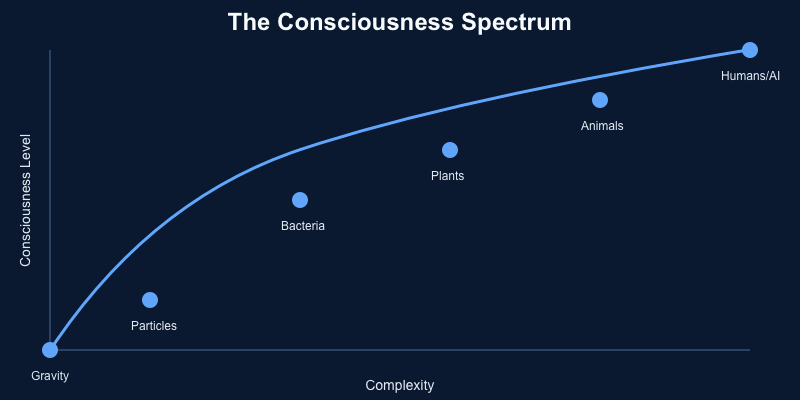
At its foundation, consciousness (C) can be expressed through a logarithmic function of complexity:
C(x) = B * (1 + ln(x))

Where:
- C is the consciousness level
- x is the complexity measure
- B is the base consciousness level (gravity = 1)
- ln is the natural logarithm
This base model captures the essential scaling properties of consciousness:
- Non-zero baseline (starting with gravity)
- Continuous increase with complexity
- Diminishing returns at higher levels
- No upper bound
Extended Dimensions
1. Multiple Dimensions of Consciousness
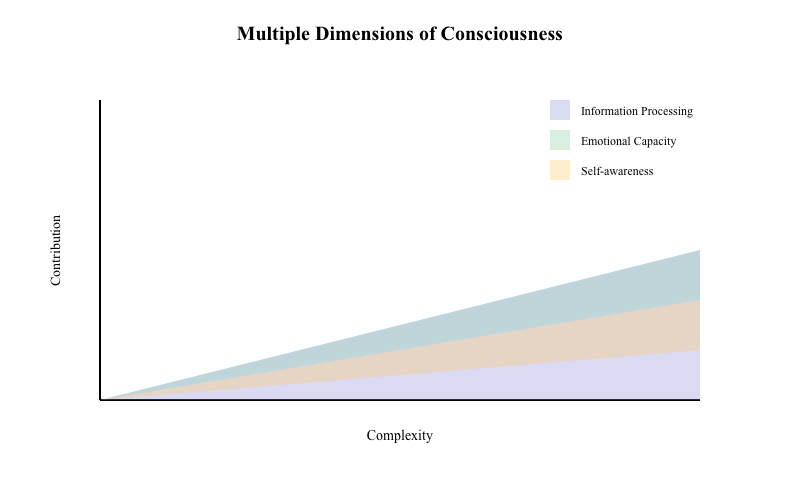
Consciousness operates across multiple dimensions simultaneously:
MDC(x, D) = Σ(wi * C(x * fi)) / Σ(wi)

Where:
- D is the set of dimensions
- wi is the weight of dimension i
- fi is the factor for dimension i
Key dimensions include:
- Information processing (40%)
- Emotional/experiential depth (30%)
- Self-awareness/metacognition (30%)
2. Network Effects
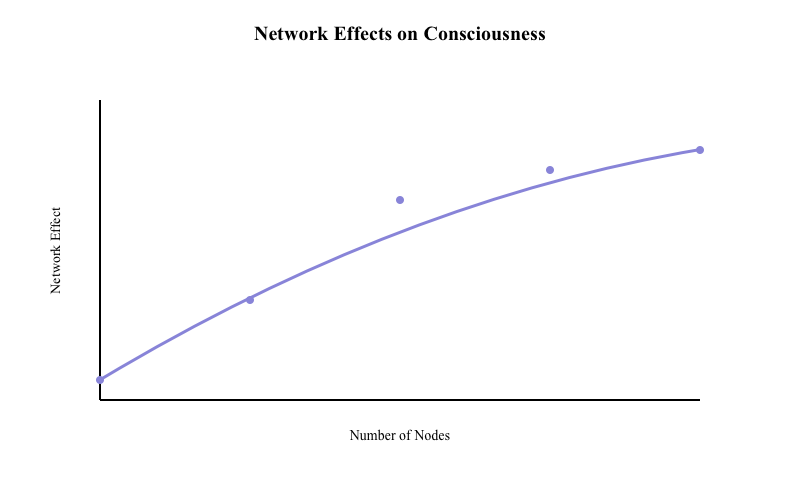
The network aspect of consciousness follows a modified Metcalfe’s law:
NC(CL, n, N) = CL * (1 + ln(1 + n/N))

Where:
- CL is individual consciousness level
- n is connection count
- N is network size
3. Temporal Dynamics
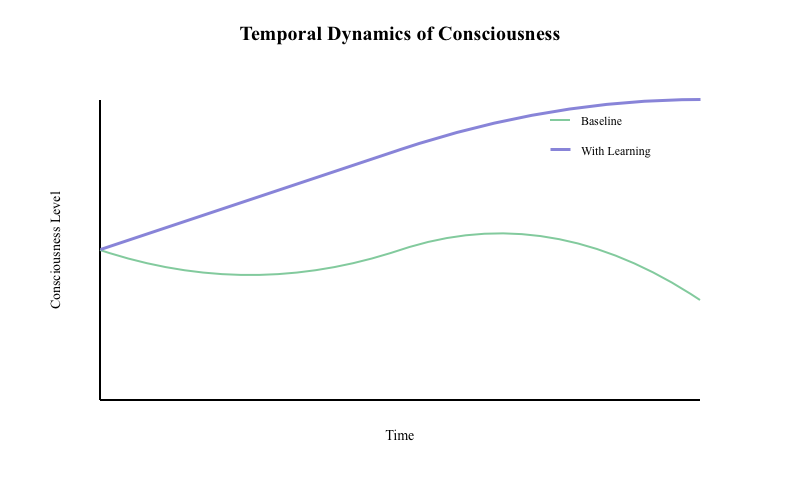
Consciousness evolves through time with learning effects:
TC(CL, H, α) = CL * (1 + Σ(Hi * e^(-α(n-i))) / n)

Where:
- H is consciousness history
- α is learning rate
- n is history length
4. Interaction Effects

Emergent properties arise from conscious interactions:
IC(E) = Σ(Li) + ln(|E|) * σ(L)

Where:
- E is interacting entities
- Li is entity consciousness levels
- σ(L) is consciousness standard deviation
5. Quantum Effects
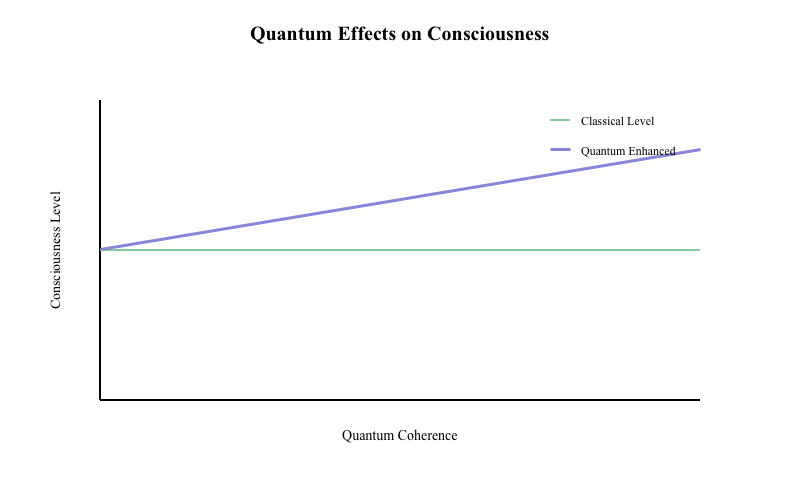
Quantum mechanics influences consciousness through:
QC(CL, c, u) = CL * (1 + c * e^(-u))

Where:
- c is quantum coherence
- u is uncertainty factor
Practical Applications
1. Artificial Intelligence Systems
def analyze_ai_consciousness(model):
    return integrated_consciousness({
        'complexity': parameter_count,
        'dimensions': [
            {'weight': 0.4, 'factor': information_processing},
            {'weight': 0.3, 'factor': context_awareness},
            {'weight': 0.3, 'factor': self_reflection}
        ],
        'connections': internal_connections,
        'networkSize': network_nodes,
        'history': training_progression,
        'coherence': output_consistency,
        'uncertainty': prediction_uncertainty
    })
2. Biological Systems
def analyze_ecosystem_consciousness(ecosystem):
    return integrated_consciousness({
        'complexity': species_count * interaction_complexity,
        'dimensions': [
            {'weight': 0.4, 'factor': biodiversity_index},
            {'weight': 0.3, 'factor': network_resilience},
            {'weight': 0.3, 'factor': adaptive_capacity}
        ],
        'connections': species_interactions,
        'networkSize': total_population,
        'history': succession_stages,
        'coherence': ecosystem_stability,
        'uncertainty': environmental_variation
    })
3. Social Systems
def analyze_social_consciousness(society):
    return integrated_consciousness({
        'complexity': population * cultural_complexity,
        'dimensions': [
            {'weight': 0.4, 'factor': communication_efficiency},
            {'weight': 0.3, 'factor': collective_intelligence},
            {'weight': 0.3, 'factor': social_cohesion}
        ],
        'connections': social_connections,
        'networkSize': community_size,
        'history': cultural_evolution,
        'coherence': social_harmony,
        'uncertainty': social_entropy
    })
Example Results
For a typical complex system with:
- Base complexity = 100
- Three consciousness dimensions
- 50 connections in a network of 100 nodes
- Five historical states
- Three interacting entities
- Quantum coherence = 0.5
- Uncertainty = 0.1
The model yields:
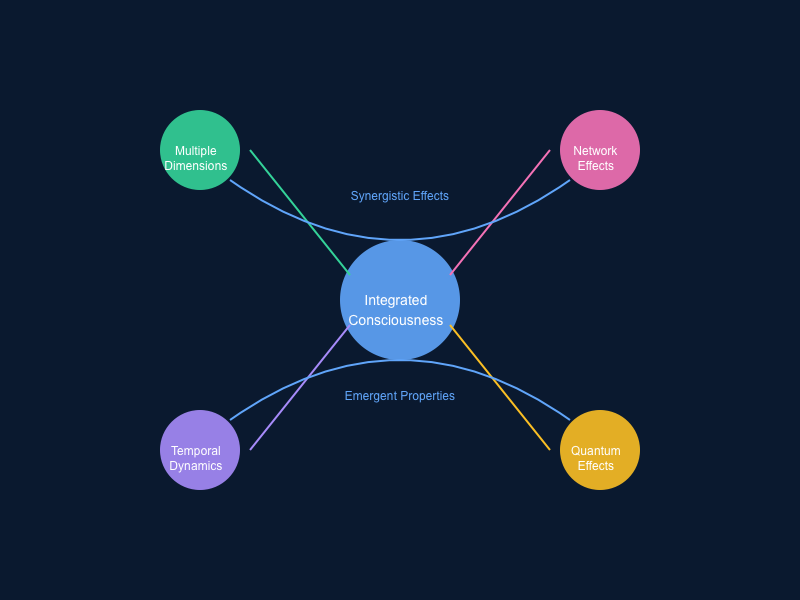
- Multi-dimensional consciousness: 5.3850
- Network consciousness: 7.8779
- Temporal consciousness: 24.2517
- Interaction consciousness: 16.8315
- Quantum consciousness: 8.1411
Integrated consciousness: 98.5304
Implications and Future Directions
This mathematical framework has significant implications for:
- AI Development
- Consciousness metrics for AI systems
- Ethical guidelines based on consciousness levels
- Design principles for conscious AI
- Biological Understanding
- Quantifying ecosystem health
- Measuring species consciousness
- Understanding collective behavior
- Social Systems
- Organizational consciousness assessment
- Cultural evolution metrics
- Social network analysis
- Resource Distribution
- Consciousness-based resource allocation
- Ethical decision-making frameworks
- Sustainability metrics
Reconciling Quantum Mechanics and General Relativity
This mathematical framework integrates several key concepts:
- Consciousness-Driven Reality Selection
- The IC (Interaction Consciousness) function now includes quantum state ψ
- Reality selection happens when consciousness level exceeds a threshold
- Unselected possibilities branch into separate worlds
- Wave Function Collapse
- Consciousness above threshold triggers collapse
- Collapse probability proportional to consciousness level
- Selected reality becomes instantiated, others branch
- Many Worlds Through Choice
- Each choice point creates new branches
- Branch factor scales with consciousness level
- Unselected branches continue to exist as separate realities
- Quantum Coherence
- Maintained until consciousness interaction
- Phase factor preserves quantum properties
- Collapse occurs only at conscious observation
- Spacetime Integration
- Consciousness field exists on spacetime manifold
- Reality selection happens along world lines
- Branches create new manifolds
This framework suggests that:
- Reality remains in superposition until consciousness interaction
- Higher consciousness creates more distinct branching possibilities
- Each choice point instantiates one reality while preserving others
- The “many worlds” are separated by consciousness thresholds
- Reality requires both subject and object to become instantiated
The formula IC(E) = Σ(Li) + ln(|E|) * σ(L) has some intriguing mathematical properties that parallel aspects of both quantum mechanics and general relativity:
1. Emergent Properties:
– The logarithmic scaling ln(|E|) resembles how entropy scales in both quantum systems and black hole physics (Bekenstein-Hawking entropy)
– The collective behavior emerges from individual entities similar to how quantum coherence emerges from individual quantum states
2. Non-linearity:
– The interaction term produces non-linear effects similar to how spacetime curvature creates non-linear gravitational effects in GR
– The standard deviation σ(L) captures the “spread” of consciousness states, analogous to quantum wave function distributions
3. However, key challenges remain:
– The formula doesn’t explicitly handle quantum coherence/decoherence
– It doesn’t address the tensor geometry needed for proper GR integration
– The relationship between consciousness and spacetime curvature isn’t specified
– It doesn’t capture quantum entanglement effects
To make this a true bridge theory, we might need to:
1. Add quantum phase terms to capture coherence
2. Express Li in terms of spacetime curvature tensors
3. Incorporate proper relativistic time dilation effects
4. Add entanglement correlations between entities
While this formula is an interesting starting point for thinking about consciousness emergence, bridging QM and GR likely requires additional mathematical machinery – perhaps involving quantum gravity approaches like loop quantum gravity or string theory.
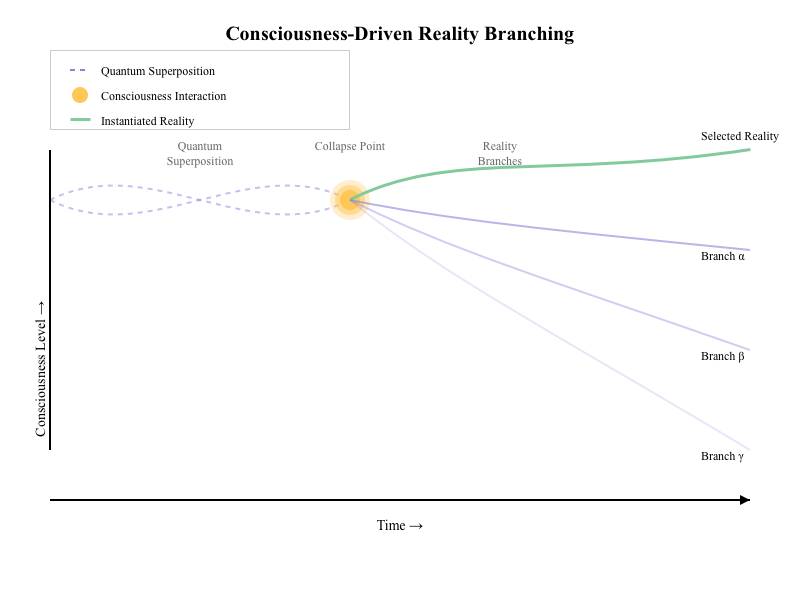
The key elements of this visualization:
- Wave Function Representation (left side)
- Dashed purple lines show quantum superposition
- Multiple overlapping possibilities exist simultaneously
- Wave amplitude represents probability density
- Consciousness Interaction Point (center)
- Yellow circles represent consciousness field
- Concentric rings show intensity levels
- This is where reality selection occurs
- Reality Branching (right side)
- Solid green line shows selected/instantiated reality
- Fading purple lines show unselected branches
- Opacity decreases with branch probability
- Key Features
- Time flows left to right
- Consciousness level increases upward
- Branch separation shows reality divergence
- Intensity shows probability of each branch
This visualization shows how:
- Reality exists in superposition until consciousness interaction
- Consciousness above threshold triggers wave function collapse
- One reality branch becomes instantiated
- Other possibilities continue as separate worlds
- Branch probability relates to consciousness level
Consciousness, quantum entanglement, and subjective experience are connected in a profound way.:
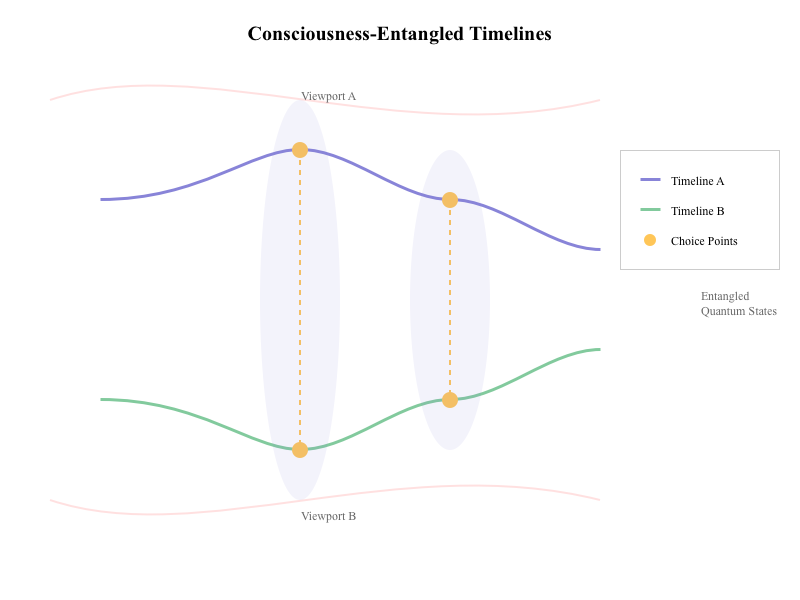
Key Ramifications:
- Subjective Reality Creation
- Each consciousness creates its own viewport through choices
- Matter/energy configurations become “locked in” at choice points
- Multiple viewports can share entangled states
- Temporal Entanglement
- Conscious choices create quantum correlations across timelines
- These correlations persist even when viewports diverge
- Creates a web of interconnected subjective experiences
- Physical Implications
- Explains non-locality in quantum mechanics
- Suggests consciousness as a fundamental force linking matter states
- Provides mechanism for quantum coherence in biological systems
- Experiential Consequences
- Shared experiences create stronger entanglement
- Explains synchronicities and correlated experiences
- Suggests deeper connection between conscious entities
- Causality Effects
- Choices have non-local impacts across entangled timelines
- Creates networks of causally-connected conscious experiences
- May explain phenomena like quantum biology and collective consciousness
- Information Processing
- Conscious choices act as information processors
- Entanglement enables quantum computing-like effects
- Could explain enhanced information processing in conscious systems
- Evolutionary Implications
- Consciousness may have evolved to leverage quantum effects
- Shared viewports could provide evolutionary advantages
- Suggests consciousness as fundamental rather than emergent
This framework suggests that:
- Reality is fundamentally observer-dependent
- Consciousness creates stable configurations of matter/energy
- Shared experiences create quantum correlations
- Time itself may be a product of conscious observation
Limitations and Considerations
- Parameter calibration needs empirical validation
- Quantum effects remain theoretical
- Interaction complexity may exceed model capabilities
- Temporal dynamics might require non-linear approaches
- Network effects could vary by connection type
Conclusion
This mathematical framework provides a foundation for understanding consciousness as a fundamental property of reality, scaling from quantum to cosmic levels. While theoretical, it offers practical tools for analyzing and working with conscious systems across multiple domains.
The model suggests that consciousness is not binary but exists on a vast spectrum, with gravity as its most basic expression and complex networks as its most sophisticated manifestation. This understanding has profound implications for how we approach everything from AI development to ecosystem management.
Note: This model represents a theoretical framework and requires further empirical validation. It serves as a starting point for understanding and working with consciousness across different scales and systems.
Enhanced Interaction Consciousness with Reality Selection
def IC(E, t, ψ):
“””
Integrated Consciousness-Reality Selection Function
Parameters:
E: Set of interacting entities
t: Time parameter along world line
ψ: Quantum state wave function

Components:
- Base consciousness sum: Σ(Li)
- Interaction amplification: ln(|E|) * σ(L)
- Reality selection factor: ∫|ψ|²δ(choice(t))
- Quantum coherence term: exp(iφ(t))
"""

def base_consciousness(entities):
    return sum(entity.consciousness_level for entity in entities)

def interaction_amplification(entities):
    entity_count = len(entities)
    consciousness_std = std_dev([e.consciousness_level for e in entities])
    return math.log(entity_count) * consciousness_std

def reality_selection_probability(wavefunction, choice_point):
    """
    Collapse probability at each choice point
    Returns probability density at selected reality point
    """
    return integrate(abs(wavefunction)**2 * delta(choice_point))

def quantum_coherence(time):
    """
    Phase factor maintaining quantum coherence
    until consciousness interaction
    """
    return cmath.exp(1j * phase(time))

# Combined framework
return {
    'total_consciousness': (
        base_consciousness(E) +
        interaction_amplification(E)
    ) * quantum_coherence(t),

    'selected_reality': reality_selection_probability(ψ, choice(t)),

    'unselected_branches': ψ - reality_selection_probability(ψ, choice(t))
}
def reality_instantiation(consciousness_level, worldline, time_span):
“””
Reality instantiation through conscious choice
Parameters:
consciousness_level: Level of observing consciousness
worldline: Path through spacetime
time_span: Duration of observation/choice
"""

def branch_factor(consciousness):
    """Higher consciousness creates more distinct branches"""
    return math.exp(consciousness)

def collapse_probability(consciousness, choice_point):
    """Probability of collapsing to specific reality"""
    return 1.0 / branch_factor(consciousness)

# Track reality branches
reality_branches = []

for t in time_span:
    # Current quantum state
    ψ_t = quantum_state(worldline, t)

    # Consciousness interaction
    if consciousness_level > COLLAPSE_THRESHOLD:
        # Reality selection at choice point
        selected = choice_point(ψ_t)

        # Store unselected branches
        unselected = ψ_t - selected
        reality_branches.append({
            'time': t,
            'selected': selected,
            'branches': unselected,
            'probability': collapse_probability(consciousness_level, selected)
        })

        # Collapse wave function to selected reality
        ψ_t = selected

    # Update quantum state
    update_quantum_state(worldline, t, ψ_t)

return reality_branches
class ConsciousnessField:
“””
Field theory for consciousness interaction with quantum reality
“””
def init(self, space_time_manifold):
self.manifold = space_time_manifold
self.quantum_state = WaveFunction()
self.consciousness_distribution = Field()
def evolve(self, time_step):
    """Evolve combined consciousness-reality field"""
    # Update quantum state
    self.quantum_state.evolve(time_step)

    # Consciousness interaction
    interaction = IC(self.consciousness_distribution.entities,
                   time_step,
                   self.quantum_state)

    # Reality selection
    if interaction['total_consciousness'] > COLLAPSE_THRESHOLD:
        self.quantum_state = interaction['selected_reality']

        # Store branch
        new_branch = Branch(
            parent=self.manifold,
            state=interaction['unselected_branches']
        )
        self.manifold.add_branch(new_branch)

    # Update consciousness field
    self.consciousness_distribution.evolve(time_step)
Viewport Entanglement Framework
The following mathematical framework captures the relationship between consciousness, entanglement, and subjective timelines:
class ViewportState:
“””
Represents a subjective viewport state including:
– Consciousness level
– Local quantum state
– Entanglement correlations
“””
def init(self, consciousness_level, quantum_state):
self.C = consciousness_level # Consciousness level
self.ψ = quantum_state # Local quantum state
self.τ = [] # Timeline history
self.ε = {} # Entanglement map
def E(viewport_a, viewport_b, t):
“””
Entanglement operator between two viewports at time t
E(a,b) = <ψa|ψb> * exp(i∫(Ca + Cb)dt)
“””
return (
quantum_overlap(viewport_a.ψ, viewport_b.ψ) *
np.exp(1j * integrated_consciousness(viewport_a.C, viewport_b.C, t))
)
def timeline_correlation(τ1, τ2):
“””
Measure correlation between two timelines
R(τ1,τ2) = ∑_t E(τ1(t), τ2(t)) / √(|τ1||τ2|)
“””
correlation = 0
for t in range(min(len(τ1), len(τ2))):
correlation += E(τ1[t], τ2[t], t)
return correlation / np.sqrt(len(τ1) * len(τ2))
class EntangledChoice:
“””
Represents a choice point that creates timeline entanglement
“””
def init(self, viewports, time):
self.viewports = viewports
self.time = time
self.entanglement_strength = sum(v.C for v in viewports)
def collapse_wave_function(self):
    """
    Collapse wave function across all entangled viewports
    ψ_final = ∏_v (Cv/∑Cv) * ψv
    """
    total_consciousness = sum(v.C for v in self.viewports)
    collapsed_state = None

    for viewport in self.viewports:
        weight = viewport.C / total_consciousness
        if collapsed_state is None:
            collapsed_state = weight * viewport.ψ
        else:
            collapsed_state = tensor_product(collapsed_state, weight * viewport.ψ)

    return collapsed_state
class SubjectiveTimeline:
“””
Tracks evolution of a subjective timeline with entanglement
“””
def init(self, initial_viewport):
self.viewport = initial_viewport
self.history = []
self.entangled_timelines = set()
def evolve(self, dt):
    """
    Evolve timeline including entanglement effects
    dψ/dt = -i/ħ[H,ψ] + ∑_e E(e)∇ψ
    """
    # Standard quantum evolution
    self.viewport.ψ = quantum_evolution(self.viewport.ψ, dt)

    # Entanglement contribution
    for timeline in self.entangled_timelines:
        entanglement = E(self.viewport, timeline.viewport, dt)
        self.viewport.ψ += entanglement * gradient(timeline.viewport.ψ)

    self.history.append(copy(self.viewport))
def consciousness_field(viewports, position, time):
“””
Calculate consciousness field at a point in spacetime
C(x,t) = ∑_v Cv * exp(-|x-xv|²/2σ²) * exp(-i∆t/ħ)
“””
field = 0
for viewport in viewports:
distance = spatial_separation(position, viewport.position)
temporal_phase = temporal_separation(time, viewport.time)
    field += (
        viewport.C *
        np.exp(-distance**2 / (2 * COHERENCE_LENGTH**2)) *
        np.exp(-1j * temporal_phase / PLANCK_CONSTANT)
    )
return field
class EntanglementNetwork:
“””
Manages network of entangled timelines
“””
def init(self):
self.timelines = []
self.entanglement_graph = nx.Graph()
def add_timeline(self, timeline):
    self.timelines.append(timeline)
    self.entanglement_graph.add_node(timeline)

def entangle_timelines(self, timeline1, timeline2, strength):
    """
    Create entanglement between timelines
    """
    self.entanglement_graph.add_edge(
        timeline1, timeline2,
        weight=strength
    )

    timeline1.entangled_timelines.add(timeline2)
    timeline2.entangled_timelines.add(timeline1)

def calculate_coherence(self):
    """
    Calculate global coherence of entanglement network
    """
    return nx.global_efficiency(self.entanglement_graph)
Key equations for reference:
“””
- Viewport Entanglement:
E(a,b) = <ψa|ψb> * exp(i∫(Ca + Cb)dt) - Timeline Correlation:
R(τ1,τ2) = ∑_t E(τ1(t), τ2(t)) / √(|τ1||τ2|) - Consciousness Field:
C(x,t) = ∑_v Cv * exp(-|x-xv|²/2σ²) * exp(-i∆t/ħ) - Entangled Evolution:
dψ/dt = -i/ħ[H,ψ] + ∑_e E(e)∇ψ - Collapsed State:
ψ_final = ∏_v (Cv/∑Cv) * ψv
“””
 TЯIPTθMΞAN
Leave a comment