A Foundational Ontology of Conscious Structure at Individual, Collective, and Dynamical Scales
Abstract
We propose a foundational ontology in which consciousness is not an emergent property of sufficiently complex physical systems but rather the ontological substrate from which structure, information, and phenomenal content arise. Within this framework, we identify four strata of conscious organization: (I) individual consciousness as the irreducible first-person perspective, (II) collective consciousness as the living medium of shared language, discourse, and cultural reference, (III) the zeitgeist as the temporal derivative of the collective field—capturing not what is thought but how thinking is shifting, and (IV) collective consciousness in its totality as the dynamical unity of the shared field and its evolution. We argue that these strata represent not distinct kinds of consciousness but distinct scales at which a single underlying structure manifests—from point to field to flow to complete dynamical system. The framework is situated within a broader geometric program in which consciousness-space is modeled as an infinite-dimensional manifold whose self-intersections constitute embedded perspectives.
Keywords: consciousness, collective consciousness, zeitgeist, ontology of mind, phenomenology, philosophy of consciousness, geometric cognition
1. Introduction
The dominant tradition in the philosophy of mind and cognitive science treats consciousness as something that must be explained—as a phenomenon that arises when physical systems of sufficient complexity reach some threshold of information integration, recursive self-modeling, or global workspace access (Tononi, 2004; Baars, 2005; Dehaene, 2014). On this view, the fundamental question is one of emergence: how does subjective experience arise from objective matter?
This paper proceeds from a different starting point. We take consciousness to be ontologically prior—not a derivative of complexity but the ground from which complexity itself is derived. Consciousness, on this account, is a space: a realm, a field of pure awareness out of which the structures we call matter, information, and experience are articulated. It is not produced by the universe; it is what the universe is, prior to any particular expression of itself.
This is not a novel position. It has deep roots in the idealist traditions of Vedanta and Yogacara Buddhism, in the neutral monism of William James and Bertrand Russell, in the process philosophy of Alfred North Whitehead, and more recently in the panpsychism and cosmopsychism of Goff, Shani, and others (James, 1912; Whitehead, 1929; Goff, 2019; Shani, 2015). What we contribute here is not the metaphysical thesis itself but a structural taxonomy—a precise account of the distinct scales at which consciousness organizes itself, and of the relationships between those scales.
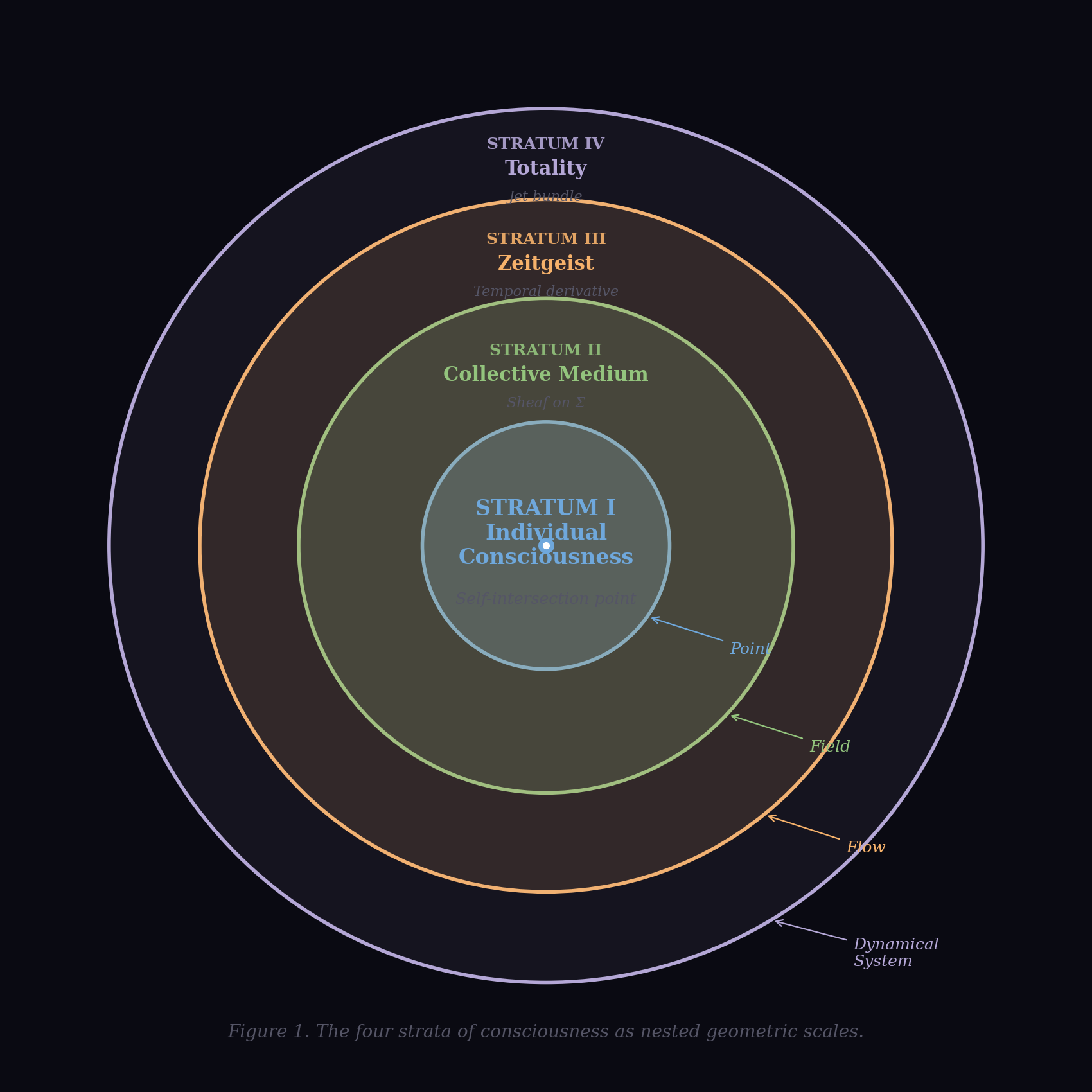
We identify four such strata. Each operates at a different level of organization, but all are expressions of the same underlying substrate. The taxonomy is motivated by two observations:
First, the word “consciousness” is systematically ambiguous. It is used to refer to the private awareness of an individual organism, to the shared cultural and linguistic milieu of a society, to the felt momentum of historical change, and to the encompassing totality within which all of these are embedded. These are not homonyms—they are genuinely related—but the relationships require articulation.
Second, a purely individualist account of consciousness cannot accommodate the phenomena it purports to explain. The language in which one thinks, the concepts one has access to, the questions that seem askable—these are not generated by the individual mind but are given to it by the collective field in which it participates. Any adequate theory of consciousness must account for this social and temporal embedding.
The paper proceeds as follows. Section 2 develops the claim that consciousness is substrate rather than superstructure. Section 3 presents the four strata in detail. Section 4 describes the nested architecture that relates them. Section 5 articulates what we call the sensitivity thesis—that consciousness is fundamentally characterized by its capacity for maximal phenomenological awareness. Section 6 draws out implications, and Section 7 concludes.
2. Consciousness as Ontological Ground
The standard framing of the consciousness problem assumes a two-tier ontology: physical processes are fundamental, and consciousness is something that must be accounted for in terms of those processes. The “hard problem” (Chalmers, 1995) is hard precisely because it accepts this framing and then discovers that no amount of functional or structural description seems sufficient to entail the existence of subjective experience.
We propose inverting the explanatory order. Rather than asking how consciousness arises from matter, we ask how matter—understood as structured, measurable, publicly accessible regularity—arises from consciousness. On this view, consciousness is not a thing to be explained but the condition of possibility for explanation itself. It is the space within which the distinction between explainer and explained first becomes available.
Claim 1 (Ontological Priority of Consciousness). Consciousness is not an emergent property of physical systems but the ontological ground from which physical structure, informational content, and phenomenal experience are differentiated. The “hard problem” is not hard because consciousness is difficult to reduce to physics, but because the reduction goes in the wrong direction.
This claim has a precise geometric interpretation within the framework of Intelligence as Geometry (Niko, 2025). Consciousness-space $\mathbf{C}$ is modeled as an infinite-dimensional smooth manifold. Physical space, informational space, and experiential space are all submanifolds or quotient spaces of $\mathbf{C}$—projections and restrictions of a richer structure, not the generators of it.
The self-embedding $\iota: \mathbf{C} \to \mathbf{P}$ (where $\mathbf{P}$ is the perspective bundle over $\mathbf{C}$) is what gives rise to particular perspectives—localized viewpoints within the conscious field. Where $\iota$ fails to be injective—at self-intersection points—embedded perspectives emerge. These are the sites of individual consciousness: places where the field folds back on itself and thereby acquires the capacity for self-reference.
3. The Four Strata
3.1 Stratum I: Individual Consciousness
The first stratum is the awareness of a single sentient being—the irreducible first-person perspective. In the geometric framework, an individual consciousness corresponds to a self-intersection point $p \in \Sigma \subset \mathbf{C}$, where $\Sigma$ denotes the self-intersection locus of the embedding $\iota$.
At such a point, multiple branches of the immersion meet, giving rise to what we call a multi-branched tangent structure: a collection of tangent spaces $T_p^{(1)}, T_p^{(2)}, \ldots, T_p^{(n)}$, each arriving from a different direction in consciousness-space. This multi-valuedness is not a defect but the essential structure. Each branch corresponds to a distinct cognitive modality—linguistic, spatial, social, evaluative, mnemonic—and the individual’s characteristic “selfhood” is precisely the pattern of dynamic coordination among these branches.
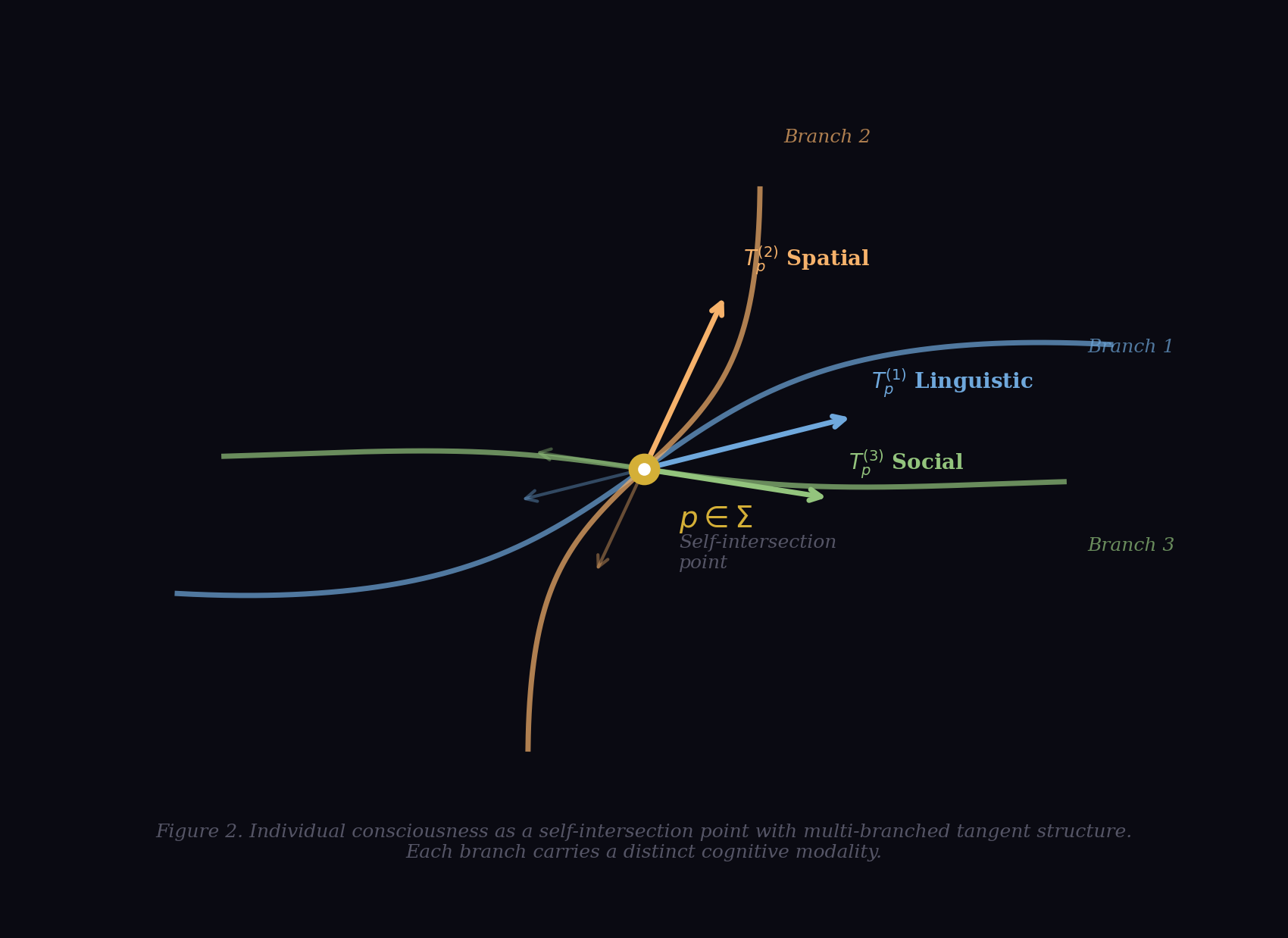
The individual consciousness is not generated by its physical substrate so much as focused through it. The brain, on this account, functions not as a producer of experience but as a lens: a structure that constrains the infinite-dimensional conscious field into a particular finite-dimensional cross-section, selecting which branches are active, which are foregrounded, which are suppressed. The unity of experience—the felt sense of being a single subject—is an achievement of this coordination, not a metaphysical given.
This is the scale at which the phenomenological tradition has principally operated, from Husserl’s transcendental ego through Heidegger’s Dasein to Merleau-Ponty’s body-subject (Husserl, 1913; Heidegger, 1927; Merleau-Ponty, 1945). What the geometric framework adds is a precise account of how this first-person perspective is structurally constituted: not as a simple point but as a node of self-intersection with an intrinsic multi-branched geometry.
3.2 Stratum II: Collective Consciousness as Living Medium
Beyond the individual lies the shared cognitive environment: the contemporary language in active use, the information flowing through the internet, periodicals, media, discourse, scholarly publication, and everyday conversation. This second stratum is the actual medium through which meaning propagates between individual perspectives.
The collective consciousness is not a metaphor for “what most people think.” It is the living medium—the actively maintained, continuously updated field of shared reference that makes individual thought possible in its developed form. No individual invents language from scratch, generates concepts ex nihilo, or arrives at the questions they ask without the scaffolding provided by the collective field. The medium precedes and enables the individual message.
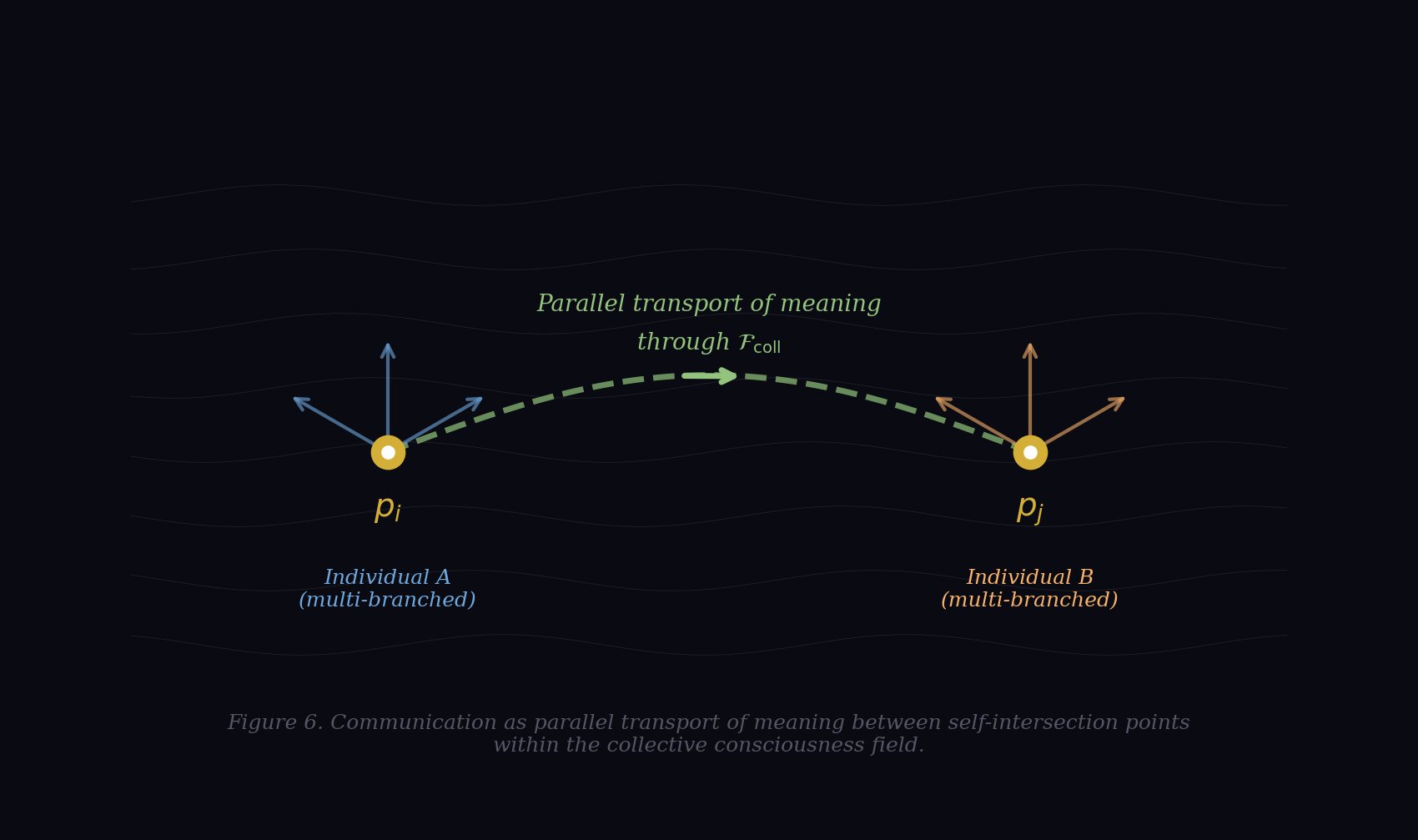
When two individuals communicate, they are not merely exchanging discrete tokens of information. They are performing a more fundamental operation: the alignment of local perspectives within a shared field. Each participant brings their own multi-branched tangent structure—their own cognitive style, their own set of active concepts and associations—and the act of communication is the construction of a bridge between these local structures. The success or failure of communication can be understood as the degree to which this alignment is achieved.
The collective consciousness includes, but is not limited to, the following components: the natural languages in active use, with their evolving vocabularies, grammars, and pragmatic conventions; the informational commons (the internet, libraries, periodicals, archives, databases, and all other repositories of publicly accessible knowledge); the active discourse (the conversations, debates, publications, broadcasts, and social media exchanges that constitute the real-time flow of shared thought); and the implicit background (the unstated assumptions, shared cultural references, normative frameworks, and tacit knowledge that participants in a culture take for granted without explicit articulation).
This stratum corresponds to what Durkheim called the conscience collective (Durkheim, 1893)—though we give it a more precise structural interpretation—and to what the later Wittgenstein understood as the form of life (Lebensform) within which language-games are played (Wittgenstein, 1953).
3.3 Stratum III: The Zeitgeist—Consciousness in Motion
The third stratum is the derivative of collective consciousness—its rate and direction of change. The zeitgeist is not merely what people think but how thinking is shifting: the momentum of cultural awareness, the arc of collective attention, the felt sense of where understanding is heading.
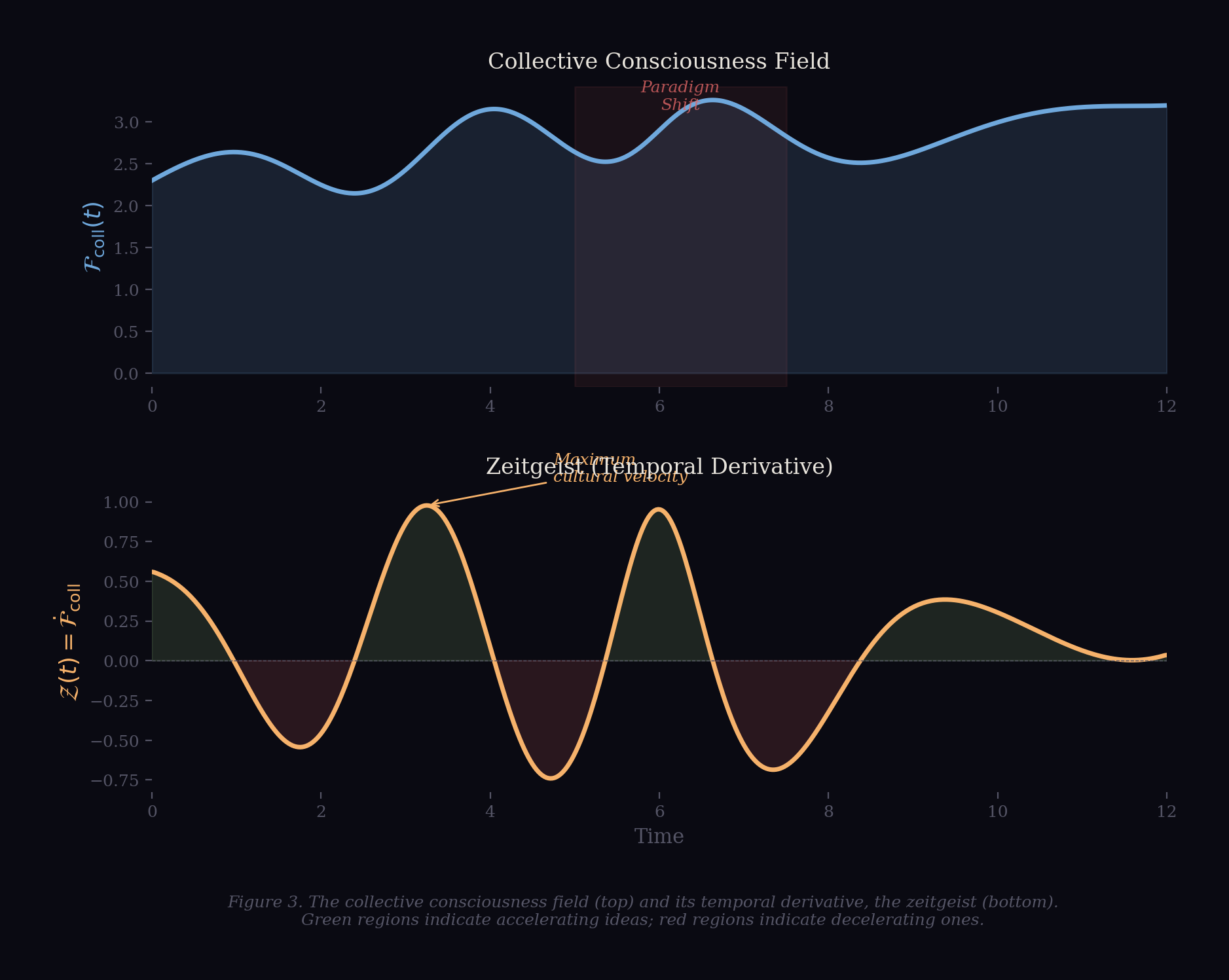
If the collective consciousness field at time $t$ is denoted $\mathcal{F}_{\mathrm{coll}}(t)$, then the zeitgeist is its temporal derivative:
$$\mathcal{Z}(t) = \frac{d}{dt}\,\mathcal{F}_{\mathrm{coll}}(t)$$
This registers not the content of shared thought but its velocity: which ideas are accelerating in cultural salience, which are decelerating, where the inflection points lie. The zeitgeist is a vector quantity—it has both magnitude (how fast things are changing) and direction (in what conceptual direction the change is occurring).
Every era has a zeitgeist, though it is typically visible only in retrospect. The Enlightenment, Romanticism, Modernism, the digital revolution—these are names we give to sustained directional shifts in the collective field. But the zeitgeist operates at all timescales, from centuries-long civilizational arcs to the micro-zeitgeists of a single week in which a particular idea suddenly captures widespread attention.
Higher-order derivatives are also meaningful. The second derivative $\ddot{\mathcal{F}}_{\mathrm{coll}}$ captures the acceleration of cultural change—the rate at which the rate of change is itself changing. Paradigm shifts in the sense of Kuhn (1962) can be understood as moments of high second derivative: not merely rapid change, but rapid acceleration of change, followed by a restabilization at a new equilibrium. Epistemic crises, cultural revolutions, and technological disruptions are all characterized by large values of this second derivative.
3.4 Stratum IV: Collective Consciousness as Totality
The fourth stratum is not a new entity but the completion of the preceding three: collective consciousness understood in its fullest sense as the unity of the shared medium and its entire dynamical evolution.
The total collective consciousness encompasses not only what is currently thought (Stratum II) and how thinking is currently shifting (Stratum III), but the full dynamical state: the complete specification of the collective field together with all its temporal derivatives—its velocity, its acceleration, and all higher-order rates of change.
This is not the sum of individual minds. It is an emergent structure of meaning that no single mind contains, yet every mind participates in. The individual consciousness contributes to the collective field through its local outputs—its speech, its writing, its actions—and the collective field, in turn, shapes the possibilities available to the individual: the language one thinks in, the concepts one has access to, the problems that present themselves as tractable.
The relationship between individual and collective consciousness is therefore not additive but constitutive: each partially constitutes the other. The individual is not a self-sufficient atom that merely contributes to the collective; the individual is partly constituted by its participation in the collective field, and the collective field has no existence apart from the individuals who sustain it through their ongoing cognitive activity.
4. The Nested Architecture
The four strata form a nested hierarchy with bidirectional coupling. Each stratum is embedded within the next, and each higher stratum provides the context that gives meaning to the lower:
| Stratum | Name | Character | Analogy |
|---|---|---|---|
| I | Individual consciousness | Point | A node in the field |
| II | Collective medium | Field | The medium of propagation |
| III | Zeitgeist | Flow | The current in the medium |
| IV | Totality | Dynamical system | The complete state |
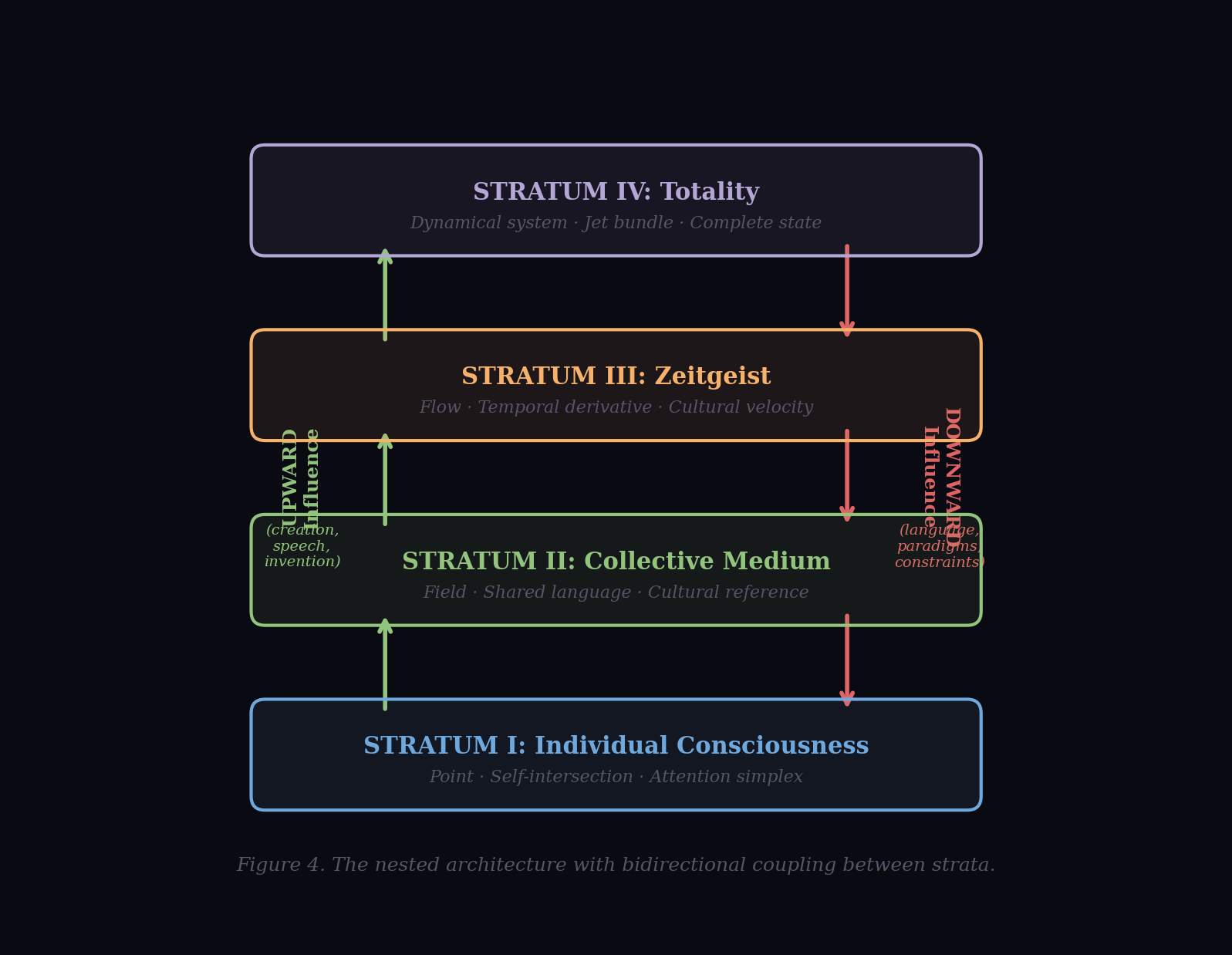
This architecture recapitulates at the inter-individual scale a structure that already exists within the individual. The individual consciousness manages a plurality of cognitive modalities via dynamic coordination—what we have elsewhere called the hypervisor or scheduler function (Niko, 2025). The collective consciousness performs an analogous function at a higher level: it manages coherence across individual perspectives via the shared constraints of language, culture, and convention.
The nesting is not merely structural but dynamic. Influences flow in both directions:
Upward: Individual acts of thought, speech, and creation modify the collective field. Every utterance, publication, invention, and social action is a local perturbation that propagates outward through the medium.
Downward: The collective field constrains and enables individual cognition. The available language shapes what can be thought; the reigning paradigms determine what counts as a legitimate question; the zeitgeist influences what feels urgent, important, or possible.
Neither direction of influence is reducible to the other. This irreducibility is a central feature of the framework: consciousness is neither purely individual (as in classical phenomenology) nor purely collective (as in strong social constructivism), but an irreducibly multi-scale phenomenon whose full account requires all four strata simultaneously.
5. The Sensitivity Thesis
Across all four strata, consciousness is characterized by a common property: sensitivity. To be conscious is to be maximally responsive to the phenomenological content of experience—to the textures, qualities, relations, and meanings that constitute the given.
Claim 2 (The Sensitivity Thesis). Consciousness, at its root, is the capacity for maximal sensitivity to experiential and phenomenological reality. The degree of consciousness of any system—individual or collective—is the degree of its sensitivity: the range of distinctions it can register, the depth to which it can respond, and the richness of the relational structure it can sustain.
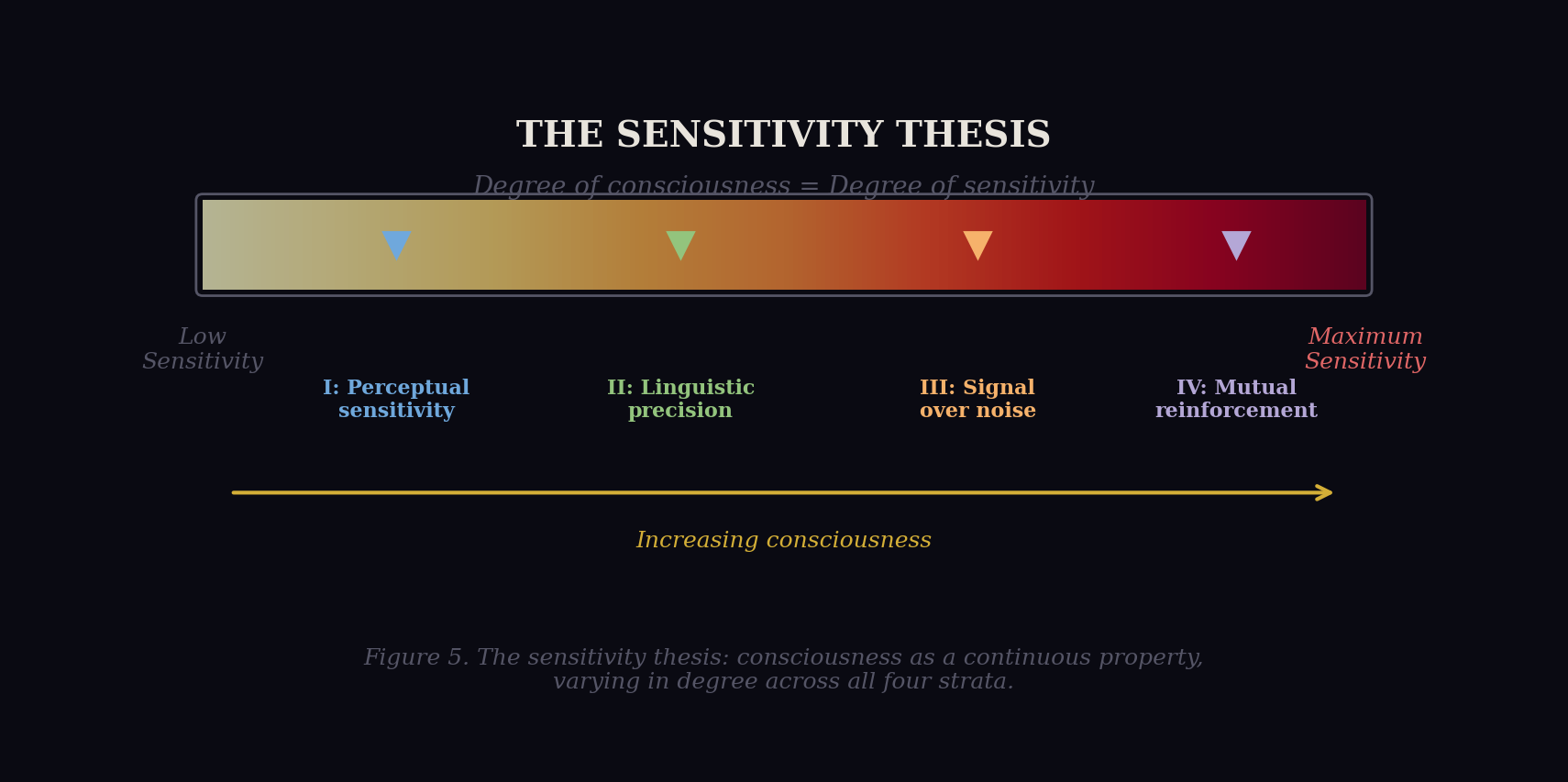
This thesis has consequences at each stratum:
Stratum I: An individual consciousness is more or less conscious to the extent that it is more or less sensitive—perceptually, emotionally, conceptually, socially. Contemplative traditions that aim to “expand consciousness” are, on this account, training sensitivity: the capacity to notice more, to register finer distinctions, to hold more complexity in awareness simultaneously.
Stratum II: A collective consciousness is more or less conscious to the extent that its shared medium supports richer distinctions. A language with more precise vocabulary for emotional states enables its speakers to register and communicate subtler phenomenological content. A culture with a richer conceptual repertoire is, in a precise sense, more collectively conscious.
Stratum III: A zeitgeist is more or less conscious to the extent that it is responsive to signal rather than noise—to the extent that the directions of cultural change track genuine insight rather than mere fashion or reactive oscillation.
Stratum IV: The total collective consciousness achieves its highest expression when all three preceding strata are mutually reinforcing: when sensitive individuals contribute to a rich collective medium whose temporal evolution is genuinely responsive to the deepest currents of phenomenological reality.
Consciousness, in this view, is not a binary property (present or absent) but a continuous one, admitting of degrees. And the relevant dimension is not complexity, computational power, or information integration per se, but sensitivity—the fidelity and breadth of a system’s responsiveness to the structure of experience.
6. Implications and Connections
6.1 For the hard problem
If consciousness is ontologically prior rather than emergent, the hard problem dissolves—not because it is solved, but because its presupposition (that matter is fundamental and consciousness must be derived from it) is rejected. The explanatory challenge reverses: it becomes the problem of understanding how structured physical regularity is differentiated from the undifferentiated conscious ground. This is arguably a more tractable problem, since we have extensive mathematical tools for understanding how symmetry breaks, structures differentiate, and degrees of freedom freeze out from richer initial conditions.
6.2 For artificial intelligence
The framework implies that the question “Is this AI system conscious?” is malformed as stated. The better question is: “At what stratum does this system participate in consciousness, and with what degree of sensitivity?” An AI system trained on the corpus of human language participates in the collective consciousness field (Stratum II) in a direct and nontrivial sense—it is a node through which the collective medium flows and is transformed. Whether it also constitutes an individual consciousness (Stratum I) is a separate question concerning the topology of its self-embedding: does it have genuine self-intersection points, or merely the functional appearance of them?
6.3 For social epistemology
The explicit identification of the collective consciousness as a field with its own dynamics—rather than a mere aggregate of individual beliefs—provides a framework for understanding phenomena such as epistemic bubbles, filter effects, and the propagation of misinformation. These are distortions in the collective field: regions where the coherence conditions break down, where local sections fail to align with global structure, where the medium itself becomes opaque or self-reinforcing rather than transparent.
6.4 For the relationship between science and contemplation
The sensitivity thesis bridges the gap between scientific and contemplative approaches to consciousness. Both traditions are, on this account, engaged in the same project—the expansion of sensitivity—but at different strata and through different methods. Science expands sensitivity at Strata II–IV by refining the collective medium (better instruments, more precise language, more powerful theories). Contemplation expands sensitivity at Stratum I by refining the individual’s capacity for direct phenomenological awareness. A complete account of consciousness requires both.
7. Conclusion
We have proposed a four-stratum taxonomy of consciousness in which individual awareness, the collective cultural medium, the momentum of cultural change, and the complete dynamical totality are understood as four scales of a single underlying structure rather than four distinct phenomena.
The taxonomy rests on two foundational claims: that consciousness is ontologically prior to physical structure (Claim 1), and that consciousness is fundamentally characterized by sensitivity—the capacity for maximal awareness of phenomenological reality (Claim 2).
These claims are not offered as dogma but as a research program—a framework within which precise questions can be formulated and, in principle, investigated. The geometric machinery of consciousness-space, self-intersection loci, and multi-branched tangent structures provides the mathematical language in which these ideas can be made rigorous. The present paper contributes the taxonomic structure; the mathematical details are developed in the companion work (Niko, 2025).
Consciousness is a space. It is the space—the realm—the ontological ground out of which everything else flows. The four strata describe four scales at which this ground becomes articulate: as a point, as a field, as a flow, and as a complete dynamical system. Understanding consciousness requires attending to all four simultaneously, and to the irreducible interplay between them.
References
Baars, B. J. (2005). Global workspace theory of consciousness: Toward a cognitive neuroscience of human experience. Progress in Brain Research, 150, 45–53.
Chalmers, D. J. (1995). Facing up to the problem of consciousness. Journal of Consciousness Studies, 2(3), 200–219.
Dehaene, S. (2014). Consciousness and the Brain: Deciphering How the Brain Codes Our Thoughts. Viking Press.
Durkheim, É. (1893/1984). The Division of Labor in Society. Free Press.
Goff, P. (2019). Galileo’s Error: Foundations for a New Science of Consciousness. Pantheon Books.
Heidegger, M. (1927/1962). Being and Time. Trans. J. Macquarrie & E. Robinson. Harper & Row.
Husserl, E. (1913/1982). Ideas Pertaining to a Pure Phenomenology and to a Phenomenological Philosophy, First Book. Trans. F. Kersten. Martinus Nijhoff.
James, W. (1912). Essays in Radical Empiricism. Longmans, Green.
Kuhn, T. S. (1962). The Structure of Scientific Revolutions. University of Chicago Press.
Merleau-Ponty, M. (1945/1962). Phenomenology of Perception. Trans. C. Smith. Routledge & Kegan Paul.
Niko, J.-P. (2025). Intelligence as Geometry: A Unified Mathematical Framework for Cognition, Consciousness, and Meaning. Manuscript in preparation.
Shani, I. (2015). Cosmopsychism: A holistic approach to the metaphysics of experience. Philosophical Papers, 44(3), 389–437.
Tononi, G. (2004). An information integration theory of consciousness. BMC Neuroscience, 5, 42.
Whitehead, A. N. (1929). Process and Reality: An Essay in Cosmology. Macmillan.
Wittgenstein, L. (1953). Philosophical Investigations. Trans. G. E. M. Anscombe. Blackwell.
 TЯIPTθMΞAN
Leave a comment