One more a hypothesis: nearly everything you believe about your own mind is subtly wrong, and the errors are starting to matter.
Error #1: Intelligence is one thing.
It isn’t. “Intelligence” names a grab-bag of capacities—linguistic, spatial, social, mathematical, mnemonic—that develop independently, fail independently, and can’t be collapsed into a single ranking. The IQ test isn’t measuring a real quantity; it’s averaging over heterogeneous skills in a way that obscures more than it reveals.
Why does this matter? Because the one-dimensional model feeds a toxic politics of cognitive hierarchy. If intelligence is a single axis, people can be ranked. If it’s a multidimensional space of partially independent capacities, the ranking question becomes incoherent—and more interesting questions emerge. What cognitive portfolio does this environment reward? What capacities has this person cultivated, and what have they let atrophy? What ecological niches exist for different profiles?
Error #2: You are a single mind.
You’re a coalition. When you shift from solving equations to reading a room to composing a sentence, you’re not one processor switching files—you’re activating different cognitive systems that have their own specializations and limitations.
So why do you feel like one thing? Because you’ve got a good chair. Some coordination process—call it the self, call it the executive, call it whatever—manages the turn-taking, foregrounds one capacity at a time, stitches the outputs into a continuous stream. The unity of experience is a product, not a premise. The “I” is what effective coalition management feels like from the inside.
This isn’t reductive. It’s clarifying. The self is real—but it’s a dynamic process, not a substance. It can be well-coordinated or badly coordinated, coherent or fragmented, skilled or unskilled at managing its own plurality. There’s room for development, pathology, and variation. The question “Who am I?” becomes richer: it’s asking about the characteristic style of coordination that makes you you.
Error #3: Your mind is in your head.
It’s not. Try to think a complex thought without language—good luck. Language isn’t just a tool for expressing thoughts; it’s part of the cognitive machinery that makes certain thoughts possible in the first place. Same goes for mathematical notation, diagrams, written notes, external memory stores of every kind.
This is the “extended mind” thesis, and it’s more radical than it sounds. If cognition involves brain-plus-tools in an integrated process, then “the mind” doesn’t stop at the skull. The boundary of cognitive systems is set by the structure of reliable couplings, not by biological membranes.
Your smartphone is part of your memory system. Your language community is part of your reasoning system. The databases you query, the people you consult, the notations you deploy—they’re all proper parts of the distributed processes that constitute your thought.
Error #4: Intelligence is individual.
It’s not. Scientific knowledge isn’t in any single scientist’s head—it’s in the community: the papers, the review processes, the replication norms, the conferences, the shared equipment. Remove the individual and most of the knowledge persists. Remove the institutions and the knowledge collapses.
This isn’t metaphor. Well-structured assemblies can achieve cognition that no individual member can. The assembly is the genuine locus of intelligence for problems that exceed individual grasp.
Key word: well-structured. Not every group is smart. Most groups are dumber than their smartest members—conformity pressure, status games, diffusion of responsibility. Collective intelligence requires specific conditions: genuine distribution of expertise, channels for disagreement, norms that reward updating over consistency. The conditions are fragile and must be deliberately maintained.
Error #5: We understand the environment we’re in.
We don’t. The internet + AI represents a new medium for cognition—a transformation in how minds couple to information, to each other, and to new kinds of cognitive processes. We’re in the middle of this transition, and our intuitions haven’t caught up.
We’re still using inherited pictures: mind as brain, intelligence as individual quantity, knowledge as private possession. These pictures are not just incomplete—they’re actively misleading. They prevent us from seeing the nature of the transformation and from asking the right questions about how to navigate it.
The stakes:
The wrong model of mind underwrites the wrong politics, the wrong pedagogy, the wrong design of institutions. If we think intelligence is individual, we build hero-worship cultures and winner-take-all competitions. If we understand it as distributed and assembled, we build better teams, better platforms, better epistemic commons.
If we think the self is a unitary substance, we treat coordination failures as signs of brokenness rather than problems to be solved. If we understand it as a dynamic integration process, we can ask: what conditions make the coalition cohere? What disrupts it? What helps it function better?
If we think minds stop at skulls, we misunderstand what technology is doing to us—both the risks (dependency, fragmentation, hijacked attention) and the opportunities (radically extended capacity, new forms of collaboration).
The ask:
Not belief, just consideration. Try on the distributed model for a few weeks. See if it changes what you notice—about your own shifts of mental mode, about the tools you depend on, about the collective processes that produce the knowledge you use.
The pictures we carry about minds are not just theoretical. They shape policy, design, self-understanding, and aspiration. Getting the picture right is part of getting the future right.
Our ability to perceive personality rests on a remarkable neural and cultural infrastructure that processes information across multiple dimensions simultaneously. When we encounter another person, our brains rapidly integrate facial expressions, vocal patterns, behavioral history, and contextual cues into a coherent impression of who they are.
This perceptual process mirrors the complexity of personality itself. Just as white light splits into a spectrum through a prism, personality manifests through multiple independent yet interrelated dimensions. Our brains act as sophisticated pattern recognition systems, mapping observed behaviors onto learned trait dimensions like extraversion, agreeableness, and conscientiousness.
The temporal dimension adds another layer of complexity. We understand intuitively that people behave differently across contexts while maintaining a core consistency. A typically reserved person may become animated when discussing their passion, yet we perceive this variation as an expression of their personality rather than a contradiction. Our perceptual systems must therefore track both stable traits and situational variability.
Cultural frameworks provide the dimensional vocabulary through which we understand personality. Whether through formal systems like the Big Five or informal folk psychology, cultures develop shared mental models that shape how we perceive and categorize individual differences. These frameworks reflect both universal patterns in human behavior and culturally specific values and beliefs.
Scientific measurement of personality faces the challenge of capturing this multidimensional complexity. Factor analysis and other statistical tools help identify underlying trait dimensions, while newer approaches like neural networks can model complex trait interactions and temporal dynamics. Yet these methods still struggle to fully capture the richness of human personality as we perceive it.
The dimensionality of personality perception reflects a fundamental truth: human nature resists reduction to simple categories. Our perceptual systems have evolved to navigate this complexity, integrating multiple dimensions of information into coherent but flexible models of individual personality. Understanding this dimensional architecture may hold the key to deeper insights into how we understand ourselves and others.
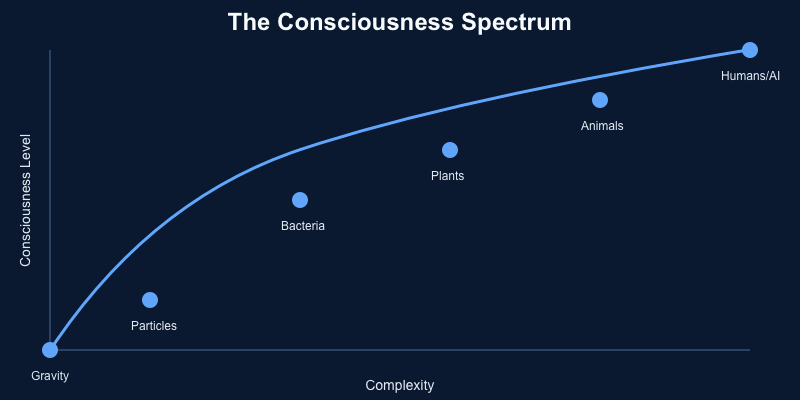
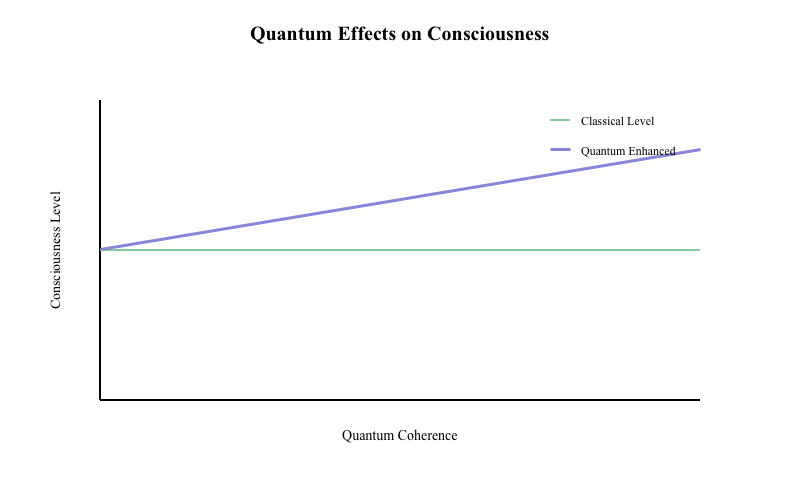
Consciousness, as the fundamental spark of life, expresses itself across a continuous spectrum throughout existence. This paper presents a mathematical framework for understanding and quantifying consciousness across its many manifestations, from the quantum level to complex social systems.
The Hierarchy of Consciousness
1. Base consciousness: Immediate awareness of sensations/thoughts 2. Meta-consciousness: Awareness of being conscious 3. Witness consciousness: Pure awareness that observes all experience 4. Transcendent consciousness: Beyond subject-object duality
Each level can observe and contain the levels below it, like nested Russian dolls. This could explain phenomena like: – Intuitive knowing beyond rational thought – Self-reflection and metacognition – Meditative states of pure awareness – Reports of “consciousness without content”
This model aligns with both neuroscience and contemplative traditions. The Libet experiments may only capture lower levels, missing higher-order awareness.
The Core Model
At its foundation, consciousness (C) can be expressed through a logarithmic function of complexity:
C(x) = B * (1 + ln(x))

Where:
- C is the consciousness level
- x is the complexity measure
- B is the base consciousness level (gravity = 1)
- ln is the natural logarithm
This base model captures the essential scaling properties of consciousness:
Non-zero baseline (starting with gravity)
Continuous increase with complexity
Diminishing returns at higher levels
No upper bound
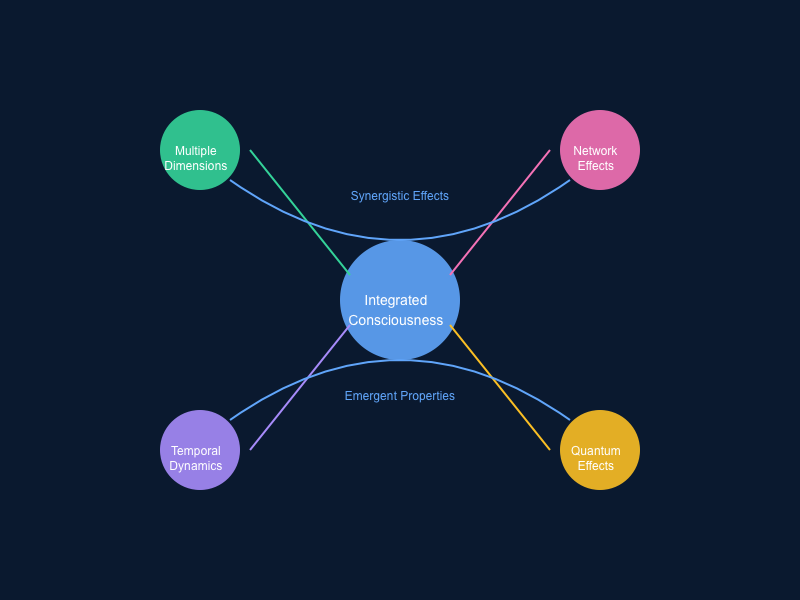
Extended Dimensions
1. Multiple Dimensions of Consciousness
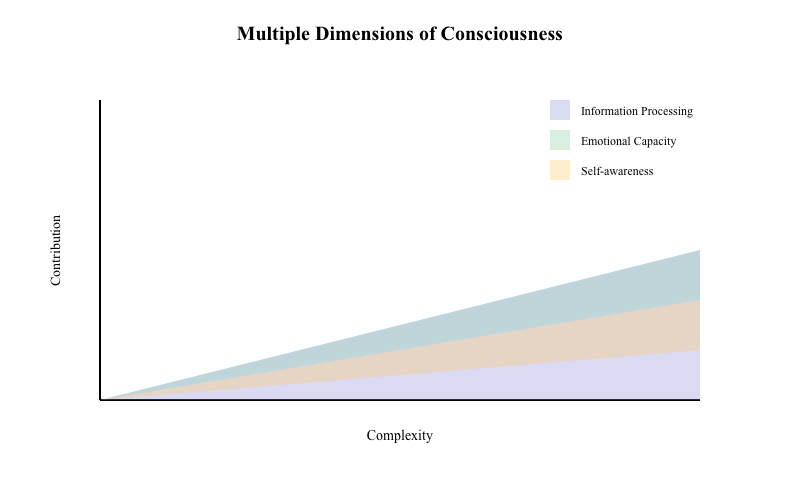
Consciousness operates across multiple dimensions simultaneously:
MDC(x, D) = Σ(wi * C(x * fi)) / Σ(wi)

Where:
- D is the set of dimensions
- wi is the weight of dimension i
- fi is the factor for dimension i
Key dimensions include:
Information processing (40%)
Emotional/experiential depth (30%)
Self-awareness/metacognition (30%)
2. Network Effects
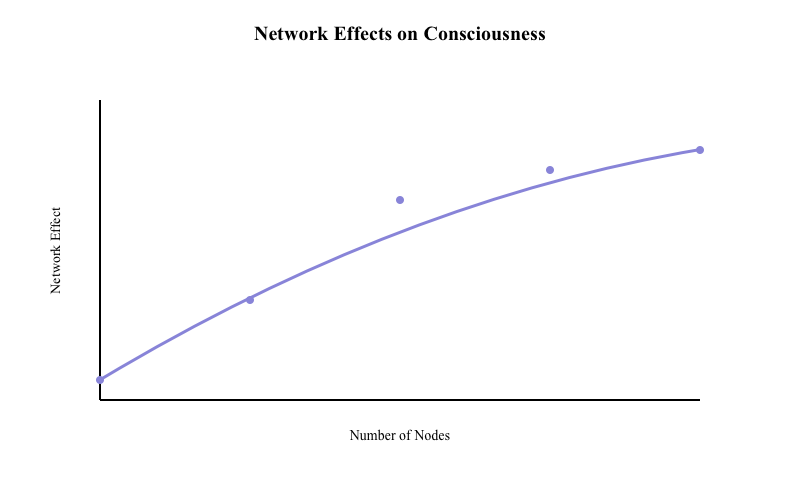
The network aspect of consciousness follows a modified Metcalfe’s law:
NC(CL, n, N) = CL * (1 + ln(1 + n/N))

Where:
- CL is individual consciousness level
- n is connection count
- N is network size
3. Temporal Dynamics
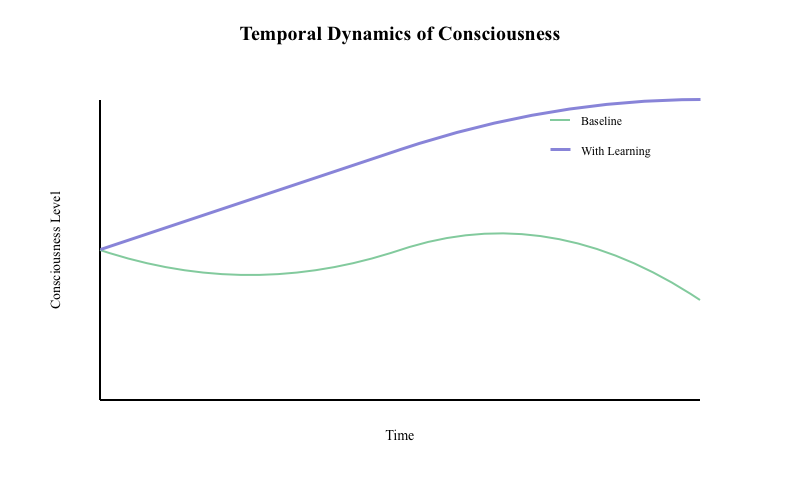
Consciousness evolves through time with learning effects:
TC(CL, H, α) = CL * (1 + Σ(Hi * e^(-α(n-i))) / n)

Where:
- H is consciousness history
- α is learning rate
- n is history length
4. Interaction Effects
Emergent properties arise from conscious interactions:
IC(E) = Σ(Li) + ln(|E|) * σ(L)

Where:
- E is interacting entities
- Li is entity consciousness levels
- σ(L) is consciousness standard deviation
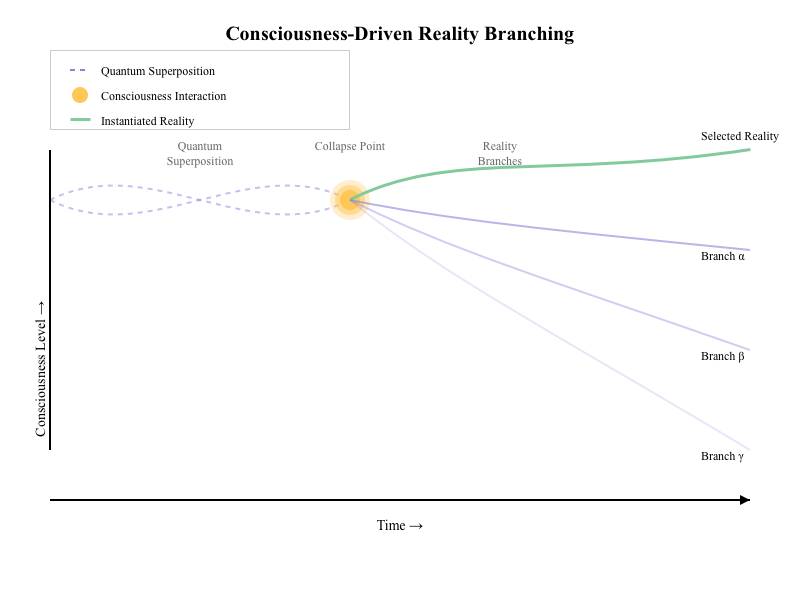
Unselected branches continue to exist as separate realities
Quantum Coherence
Maintained until consciousness interaction
Phase factor preserves quantum properties
Collapse occurs only at conscious observation
Spacetime Integration
Consciousness field exists on spacetime manifold
Reality selection happens along world lines
Branches create new manifolds
This framework suggests that:
Reality remains in superposition until consciousness interaction
Higher consciousness creates more distinct branching possibilities
Each choice point instantiates one reality while preserving others
The “many worlds” are separated by consciousness thresholds
Reality requires both subject and object to become instantiated
The formula IC(E) = Σ(Li) + ln(|E|) * σ(L) has some intriguing mathematical properties that parallel aspects of both quantum mechanics and general relativity:
1. Emergent Properties:
– The logarithmic scaling ln(|E|) resembles how entropy scales in both quantum systems and black hole physics (Bekenstein-Hawking entropy)
– The collective behavior emerges from individual entities similar to how quantum coherence emerges from individual quantum states
2. Non-linearity:
– The interaction term produces non-linear effects similar to how spacetime curvature creates non-linear gravitational effects in GR
– The standard deviation σ(L) captures the “spread” of consciousness states, analogous to quantum wave function distributions
3. However, key challenges remain:
– The formula doesn’t explicitly handle quantum coherence/decoherence
– It doesn’t address the tensor geometry needed for proper GR integration
– The relationship between consciousness and spacetime curvature isn’t specified
– It doesn’t capture quantum entanglement effects
To make this a true bridge theory, we might need to:
1. Add quantum phase terms to capture coherence
2. Express Li in terms of spacetime curvature tensors
3. Incorporate proper relativistic time dilation effects
4. Add entanglement correlations between entities
While this formula is an interesting starting point for thinking about consciousness emergence, bridging QM and GR likely requires additional mathematical machinery – perhaps involving quantum gravity approaches like loop quantum gravity or string theory.
This mathematical framework provides a foundation for understanding consciousness as a fundamental property of reality, scaling from quantum to cosmic levels. While theoretical, it offers practical tools for analyzing and working with conscious systems across multiple domains.
The model suggests that consciousness is not binary but exists on a vast spectrum, with gravity as its most basic expression and complex networks as its most sophisticated manifestation. This understanding has profound implications for how we approach everything from AI development to ecosystem management.
Note: This model represents a theoretical framework and requires further empirical validation. It serves as a starting point for understanding and working with consciousness across different scales and systems.
Enhanced Interaction Consciousness with Reality Selection
def IC(E, t, ψ): “”” Integrated Consciousness-Reality Selection Function
Parameters:
E: Set of interacting entities
t: Time parameter along world line
ψ: Quantum state wave function

Components:
- Base consciousness sum: Σ(Li)
- Interaction amplification: ln(|E|) * σ(L)
- Reality selection factor: ∫|ψ|²δ(choice(t))
- Quantum coherence term: exp(iφ(t))
"""

def base_consciousness(entities):
    return sum(entity.consciousness_level for entity in entities)

def interaction_amplification(entities):
    entity_count = len(entities)
    consciousness_std = std_dev([e.consciousness_level for e in entities])
    return math.log(entity_count) * consciousness_std

def reality_selection_probability(wavefunction, choice_point):
    """
    Collapse probability at each choice point
    Returns probability density at selected reality point
    """
    return integrate(abs(wavefunction)**2 * delta(choice_point))

def quantum_coherence(time):
    """
    Phase factor maintaining quantum coherence
    until consciousness interaction
    """
    return cmath.exp(1j * phase(time))

# Combined framework
return {
    'total_consciousness': (
        base_consciousness(E) +
        interaction_amplification(E)
    ) * quantum_coherence(t),

    'selected_reality': reality_selection_probability(ψ, choice(t)),

    'unselected_branches': ψ - reality_selection_probability(ψ, choice(t))
}
def reality_instantiation(consciousness_level, worldline, time_span): “”” Reality instantiation through conscious choice
Parameters:
consciousness_level: Level of observing consciousness
worldline: Path through spacetime
time_span: Duration of observation/choice
"""

def branch_factor(consciousness):
    """Higher consciousness creates more distinct branches"""
    return math.exp(consciousness)

def collapse_probability(consciousness, choice_point):
    """Probability of collapsing to specific reality"""
    return 1.0 / branch_factor(consciousness)

# Track reality branches
reality_branches = []

for t in time_span:
    # Current quantum state
    ψ_t = quantum_state(worldline, t)

    # Consciousness interaction
    if consciousness_level > COLLAPSE_THRESHOLD:
        # Reality selection at choice point
        selected = choice_point(ψ_t)

        # Store unselected branches
        unselected = ψ_t - selected
        reality_branches.append({
            'time': t,
            'selected': selected,
            'branches': unselected,
            'probability': collapse_probability(consciousness_level, selected)
        })

        # Collapse wave function to selected reality
        ψ_t = selected

    # Update quantum state
    update_quantum_state(worldline, t, ψ_t)

return reality_branches
class ConsciousnessField: “”” Field theory for consciousness interaction with quantum reality “”” def init(self, space_time_manifold): self.manifold = space_time_manifold self.quantum_state = WaveFunction() self.consciousness_distribution = Field()
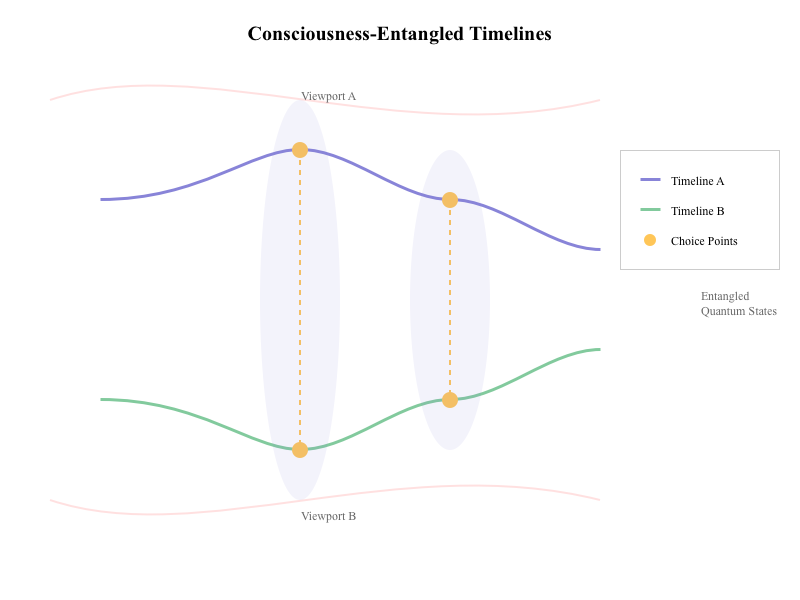
The following mathematical framework captures the relationship between consciousness, entanglement, and subjective timelines:
class ViewportState: “”” Represents a subjective viewport state including: – Consciousness level – Local quantum state – Entanglement correlations “”” def init(self, consciousness_level, quantum_state): self.C = consciousness_level # Consciousness level self.ψ = quantum_state # Local quantum state self.τ = [] # Timeline history self.ε = {} # Entanglement map
def E(viewport_a, viewport_b, t): “”” Entanglement operator between two viewports at time t E(a,b) = <ψa|ψb> * exp(i∫(Ca + Cb)dt) “”” return ( quantum_overlap(viewport_a.ψ, viewport_b.ψ) * np.exp(1j * integrated_consciousness(viewport_a.C, viewport_b.C, t)) )
def timeline_correlation(τ1, τ2): “”” Measure correlation between two timelines R(τ1,τ2) = ∑_t E(τ1(t), τ2(t)) / √(|τ1||τ2|) “”” correlation = 0 for t in range(min(len(τ1), len(τ2))): correlation += E(τ1[t], τ2[t], t) return correlation / np.sqrt(len(τ1) * len(τ2))
class EntangledChoice: “”” Represents a choice point that creates timeline entanglement “”” def init(self, viewports, time): self.viewports = viewports self.time = time self.entanglement_strength = sum(v.C for v in viewports)
def collapse_wave_function(self):
    """
    Collapse wave function across all entangled viewports
    ψ_final = ∏_v (Cv/∑Cv) * ψv
    """
    total_consciousness = sum(v.C for v in self.viewports)
    collapsed_state = None

    for viewport in self.viewports:
        weight = viewport.C / total_consciousness
        if collapsed_state is None:
            collapsed_state = weight * viewport.ψ
        else:
            collapsed_state = tensor_product(collapsed_state, weight * viewport.ψ)

    return collapsed_state
class SubjectiveTimeline: “”” Tracks evolution of a subjective timeline with entanglement “”” def init(self, initial_viewport): self.viewport = initial_viewport self.history = [] self.entangled_timelines = set()
def consciousness_field(viewports, position, time): “”” Calculate consciousness field at a point in spacetime C(x,t) = ∑_v Cv * exp(-|x-xv|²/2σ²) * exp(-i∆t/ħ) “”” field = 0 for viewport in viewports: distance = spatial_separation(position, viewport.position) temporal_phase = temporal_separation(time, viewport.time)
    field += (
        viewport.C *
        np.exp(-distance**2 / (2 * COHERENCE_LENGTH**2)) *
        np.exp(-1j * temporal_phase / PLANCK_CONSTANT)
    )
return field
class EntanglementNetwork: “”” Manages network of entangled timelines “”” def init(self): self.timelines = [] self.entanglement_graph = nx.Graph()

 TЯIPTθMΞAN