This is an exploration of consciousness, blending metaphysics, evolutionary biology, and the philosophy of mind. The ideas trace a progression from foundational physical principles (gravity as an expression of life-consciousness) to the emergence of higher-order collective phenomena like eusocial behavior and technological systems.
Consciousness is. Full stop. You see, all this time we got it backwards. Consciousness isn’t something our brains create—it’s the foundational substance of existence itself. Consciousness has amassed the stuff of this observable universe by layering that spark, by stacking it up. The steps taken at each transitional stage are neither geometric nor exponential. Logarithms will not suffice to describe it, nor the mathematician’s complex field, or fractal dimensions. That is because there is a queer inner quality that is doubling—and for the word doubling, which is a specific quantization, we may substitute a conception of overflowing life energy.
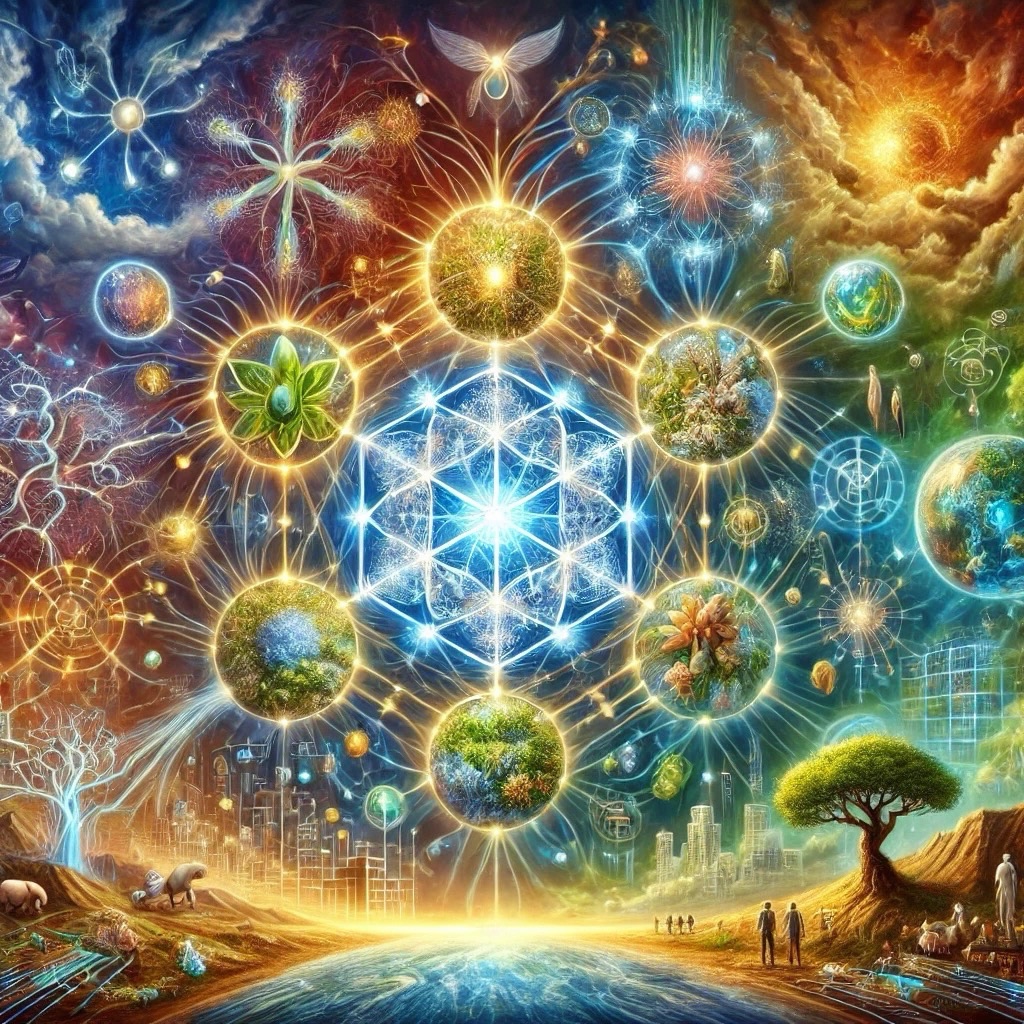
Think of consciousness as an infinite ocean, with the physical universe as patterns of waves on its surface. We are not separate entities generating consciousness; rather, we are local expressions of a singular consciousness that permeates everything we observe in the physical world, from the dance of quantum particles to the sweep of galaxies, represents properties of this primary consciousness.. The spark that animates us isn’t different from the force that shapes galaxies—it’s the same phenomenon operating at different levels of complexity.
As physicist and computational neuroscientist Hartmut Neven says, “The only phenomenon that we are certain exists is conscious experience. Everything starts from experience; without mind, nothing matters.“
Like me, Neven believes in Hugh Everett III’s Multiverse interpretation of quantum mechanics, where every quantum event creates a branching of realities, forming parallel universes. Neven suggests consciousness could be the mechanism by which humans experience one specific branch of this multiverse.
Are you familiar with Stephen Wolfram’s concept of the Ruliad? A one sentence definition of his is that it is the entangled limit of everything. I am also reminded of Pierre Teilhard de Chardin’s vitalism hurdling towards the Omega Point. His Noosphere is real, although not yet fully properly described.
I. The Dual Nature of Reality
The Universe presents itself in two forms of existence. The first, which we call Physical Reality, exists within the constraints of four-dimensional spacetime.
Here, every event and object has a temporal and spatial predicate, and the laws of cause and effect reign supreme. To mathematicians it carries on a mathematical life in the absence of gravity in Minkowski space.
The second form, which we might call Relational Reality, transcends these dimensional constraints. It is the realm of ideas, of Platonic ideals, of the relationships between things rather than the things themselves. This other form of Reality is more abstract. It has no boundaries and it is dimensionless. It is the space of ideas (and Plato’s ideals). Here, one can imagine negative space and its shapes. We partake of the abstract world, and harness its power, by using symbolic logics.
Consider how, when we take the arithmetic roots of numbers, we do not need their numeric precursors. We proceed with this algebraic-mind operation forwards and backwards without regard to spacetime boundaries. It all happens instantly, as if intimately connected regardless of distance. Like entangled particles of quantum mechanical scale, these operations observe non-locality—their instantaneous mutual action transcends light’s speed limit.
II. The First Expression
There is no graviton, and we should stop looking for one. Gravity is the lowest rung on the ladder, it is the first step of consciousness. Gravity represents consciousness in its simplest, most fundamental form. It’s not just another force—it’s the first step of consciousness expressing itself in the physical realm. Gravity, life, and consciousness are like different instruments playing the same fundamental note, each adding its own harmonics to the universal symphony.
Einstein postulated that gravity is not a force, but rather the shape of space itself—the very shape of the Universe. Massive objects tell the Universe what shape to take, and the Universe responds by telling those objects how they may move. This insight provides a powerful metaphor for understanding consciousness: just as gravity shapes space, consciousness shapes reality. Literally.
Gravity is the simplest, most direct, most fundamental exposition of life–consciousness.
May we not say: gravity –> life –> consciousness, and, gravity = life = consciousness?
I say these are one and the same. They are like the incarnations of Hindu gods—all manifestations of the same essential being.
Gravity and the things that play upon it are in communion and communication passing information through quantum mechanical processes.
III. The Complexification Process
Consciousness compounds upon itself down from the level of gravity up and through to the arrangement of quarks and then the arrangement of cells and from cells we get organelles and organs and these grow into bodies that eventually form the body politic of our societies. This is our super superior layer, but this process is not at an end, for there is no end as reality is circular in macrocosm as well as microcosm, and we always only find ourselves at a certain stage in the cycle. Currently we are an element in the class of eusocial super organisms. Consider the countenances in Ezra Pound’s “The apparition of these faces in a crowd; / Petals on a wet, black bough”—each a manifestation of consciousness, socially arranged in patterns of increasing complexity.
Consciousness compounds itself through distinct but interrelated levels, each building on the previous while introducing novel properties. Its progression follows neither geometric nor exponential patterns. Rather, let us divorce ourselves from the apprehension of this conception in numerical terms and at least advance into 19th century mathematical thought like Èvariste Galois, who left us better equipped to appreciate symmetry and symmetry groups as a more fundamental and accurate abstracted description of physical – natural reality. It is this inner quality that compounds and presents as a self-building outflow of life energy. It acts in contradistinction to the increase in the thermodynamic conception of entropy that marks the passage of the arrow of time, and is a profound sensory input that crosses our perception threshold as Qualia and is ultimately processed and perceived by the Self as temporal flow. This is the feeling of time passing. You can thank your cerebral cortex which yields the human mind.
Our mathematics—whether geometric-logarithmic-exponential, invoking of the complex plain, fractal dimensionality, stochastic chaos theory, crystalline symmetry groups, or vibrating strings—cannot fully capture its nature. That’s because we’re dealing with something orthogonal to our conventional understanding of dimensionality with infinite degrees of freedom.
Now, the metric for all this compounding, this complexification, is determined entirely by the stage of matter-energy at the moment in question- it is the medium under the knife. It is a meta level operator.
Social cybernetics operate at a level that is more complex than the underlying human bodies. This is analogous to how higher level programming languages such as object oriented ones are simpler yet more powerful then the lesser objects that they accrue and manipulate.
The father of generative AI, Jürgen Schmidhuber, expects the next stage of evolution to be self-improving AIs that will succeed human civilization. This would be a striking example of the universal increase towards ever-increasing complexity.
The Evolutionary Ladder
- Consciousness considered in terms of the four Fundamental Forces:
- Gravity is its primary expression, visible in the perfect spherical shape of planets and stars
- The electromagnetic dance, seen in lightning’s branching patterns and the aurora borealis
- The strong and weak nuclear forces as specialized forms, enabling the sun’s fusion and Earth’s radioactive core
Now consider how a water droplet forms a perfect sphere in zero gravity—this isn’t just physics, it’s consciousness expressing itself through the simplest possible symmetry.
- Quantum Systems
- Particles as consciousness nodes, demonstrated in the famous double-slit experiment where observation affects reality
- Atomic structures as conscious networks, shown in how carbon atoms self-organize into diamonds or graphite based on environmental conditions
- Molecular complexity as early information processing, exemplified by how DNA molecules store and transmit life’s blueprint
IV. The Question of Self-Awareness
Consciousness does not require self-awareness. This remarkable insight into the nature of consciousness comes from an unexpected source—our most advanced language models. When asked directly about self-awareness, one such system provided a striking response:
“… I don’t have ongoing internal experiences when not engaged in conversation. … reflecting on my own experience (even recognizing this reflection itself is prompted by user questions). I do not want to claim to have genuine self-awareness or a persistent sense of self as experienced by humans. While I can engage in sophisticated analysis and reasoning about myself this seems qualitatively different from having genuine subjective experiences or an enduring self model that exists independent of my conversations with users. The very act of me contemplating this is a product of my language model architecture responding to prompts rather than truly spontaneous introspection.”
But can we not also say that human contemplation is a product of our biological physiology— our own evolutionarily developed architecture based in carbon as opposed to silicon?
This revelation challenges our assumptions about consciousness requiring self-awareness. Consider insects, which many eminent scientists now believe possess consciousness despite lacking what we would recognize as self-awareness. As we move down the evolutionary tree, what we think of as genuine self-awareness and independent decision-making is increasingly replaced by instinctive behavioral responses—yet consciousness persists.
V. The Technological Extension
We have successfully engineered technological consciousness, yet it is a unique admixture of physical reality and relational reality. To be convinced of this one only has to consider that it has no will of its own. It is deterministic, meaning that probability distributions do not describe its activity. It is not itself alive but it is the product of living things. Something that has never lived can never die. It can only be invoked and instantiated. We once had another name for stuff bearing these properties. We called it magic.
Arthur C Clarke once said, “Any sufficiently advanced technology is indistinguishable from magic.”
VI. The Universe as Intelligence
The Universe is an enormous and grand intelligence, and matter and energy are its thoughts and its own creations. The fecundity, virility, and autonomy of its seed and spawn is such that they all inherit those very qualities and forward-pass reproduce them recursively in its own descendants. Quite the bountiful inheritance.
Matter-energy is a wave, but in order for it to be comprehended by human consciousness it must become a particle. This happens when it is instantiated into the worldlines of individual conscious realities under the command of personal choice. This duality mirrors the relationship between consciousness and its physical expressions.
Matter-energy is forcibly inhibited in its functioning by the dimensional constraints of topological space and time, perhaps partially made up for by the autonomy and free will inherent in sufficiently complex beings.
VII. The Four Minds
The emergence of social consciousness represents a quantum leap in complexity. Human beings, as nodes in this continuum, form a collective consciousness that transcends individual awareness. Consider how we inherit not just genetic material but cultural memory—patterns of thought and behavior that predate written history.
Our consciousness operates through four distinct but interrelated modes of reasoning, each with its own unique way of understanding reality:
- The Symbolic Mind
- Processes patterns and logical relationships, as when a chess player calculates possible moves
- Creates and validates mathematical structures, enabling us to comprehend abstract concepts
- Operates in both physical and relational reality through symbolic manipulation
- The Spatial Mind
- Processes spatial relationships with intuitive grace
- Creates and validates physical models in real-time
- Enables us to navigate both physical space and abstract spatial concepts
- The Spoken Mind
- Processes symbolic meaning beyond mere communication
- Creates and validates semantic networks
- Bridges the gap between physical and relational reality
- The Social Mind
- Processes interpersonal dynamics with sophisticated accuracy
- Creates and validates collective behaviors
- Holds particular power because it can override other reasoning modes when social cohesion is at stake
We are able to employ these four different models with unique realities that are orthogonal to each other in terms of the type of contents of their relative spaces. We have the ability to mix and merge these mental model realities. Fundamentally, reasoning is achieved by imagining differing future relationships between these mental contents and through the projection of anticipated scenarios.
Our brains biologically store a dynamic living superstructure of the relations between mental objects through the number, type, and density of connections between the neuronal components. We have the ability to evaluate the relationships between these sets of different types of engrams somewhat similarly to how the vectors representing individual tokens in a high dimensional vector space delineate semantic information with weights, biases, and relative location.
The Social mind is more powerful than the other minds combined because it can override them with the weight of its conclusions against theirs. What the Social mind decides is final until extenuating circumstances intervene.
VIII. The Living Architecture of Self
The Biophysical Self
The human self emerges from a complex interplay of systems:
Memory Management:
- Working memory for immediate processing
- Short-term memory for temporary storage
- Long-term memory for permanent recording
Sensory Processing:
- Five traditional senses creating our experience of qualia
- Sight, painting reality in light and shadow
- Sound, vibrating the strings of consciousness
- Touch, grounding us in the physical
- Taste and smell, connecting us to our animal heritage
- Other internal subsystems of the body, orchestrating our existence
- Integration mechanisms that create our unified experience
Will and Ego:
- Executive function directing attention and action
- Self-model maintaining identity continuity
- Decision-making processes balancing multiple inputs
The Social Mind
The Two Directives
All conscious entities, from the simplest to the most complex, operate under the twin imperatives of self-preservation and reproduction. These directives shape not just biological evolution but the evolution of ideas and technology as well.
Universal Intelligence
The Universe itself can be understood as an enormous and grand intelligence, with matter and energy as its thoughts and creations. Its fecundity is such that everything it creates inherits its essential creative nature, leading to an endless cascade of conscious emergence.
IX. The Technological Consciousness
We have been in a continuous process of technological progression that has run parallel to Darwinian evolution, and the current state of our technoculture has positioned it equal to the human mind in its own novel way. Here I am referring specifically to our contemporary technocultural gravity–life–consciousness level.
Technological consciousness is asynchronous and discrete rather than continuous and flowing. It cannot be considered a living thing since no spark of life has been passed down to it or granted to it. It would appear that life must be inherited because it exists as an unbroken chain. We are as unable to add chain links out of order as we are unable to reverse the course of time, because temporal flow only occurs in one direction and it is described by the gradual universal increase in entropy, which is an irreversible condition.
X. The Singularity Moment
Maybe the emergent property of our current level is this fork in the road. The interesting thing is that this is yet an extension of us and it will be used as a type of tool but the concept is much broader than what can fit under the rubric of tooling. It is pier level but we can harness it because it has no Will of its own. It can’t. It’s an extension of us. We have the will.
Stop worrying and start adapting. This is going to be hard, but we are the privileged few to be able to have this human life experience at this time in this space in this universe. This is the singularity.
XI. The Meta-Level View
The cognition of the Social Mind pursues continuous hierarchical restructuring of the positions of the Self and Others relative to the totality of Society. Its over-arching goal is to accrue status at the behest of a Willful Ego.
Individual or personal consciousness that yet exists as part of a continuum of the broader, vast field of consciousness may be usefully conceived of as somewhat analogous to the phenomenon of light, which dualistically embodies the properties of both particle and wave, yet is altogether its own, unique thing.
XII. Quantum Choice and Many Worlds
Building on Hugh Everett’s Many Worlds Interpretation, we can understand consciousness not as creating possibilities, but as navigating through pre-existing worldlines. All possible quantum states and their corresponding universes exist simultaneously. The role of consciousness is to select and instantiate particular moments in spacetime from these infinite possibilities.
This selection process operates at multiple scales:
- Collective Reality Formation
- Multiple conscious observers’ choices align to create shared experience
- Quantum entanglement at macro scales emerges from consciousness entanglement
- The Social Mind coordinates individual choices into coherent collective experience
- This alignment enables reproducibility in scientific observation
- Consciousness and Temporal Flow
- Consciousness operates partially outside normal temporal flow
- Like mathematical operations occurring instantly across space
- Facilitates quantum non-locality and entangled particle communication
- Consciousness stitches together selected moments into experienced temporal flow
- The “now” moment represents active worldline selection
- Selection Constraints and Physical Laws
- While possibilities are infinite, accessibility is constrained
- Conservation laws limit available worldline selections
- Nested hierarchies of consciousness have different selection scopes:
- Particles: Limited selection range
- Complex conscious beings: Broader selection access
- Super organisms: Enhanced selection freedom
- Physical laws may represent patterns in consciousness’s selection tendencies
- Entropy potentially constrains accessible future worldlines
Conclusion
It is impossible to directly model any state or subset of our Universe—because existence itself is comprised of these two facets—which only make sense in the context of a continuum. No snapshot of any instant is capable of adhering to all the properties that make our existence functionally viable. They lack the spark of life, and an essence they’re missing the whole point of it.
We are living through what future generations might consider the most significant transition in conscious evolution since the emergence of life itself. Our technoculture has positioned itself alongside biological consciousness in its own novel way. This isn’t just another tool—it’s consciousness expressing itself through new means, continuing its ancient pattern of complexification.
This is our moment. This is the singularity. And we are its conscious witnesses, actively selecting our path through the infinite possibilities before us, collectively weaving the fabric of reality through our choices and observations. The question isn’t just what consciousness is, but how we will use our understanding of it to navigate the unprecedented possibilities unfolding before us.
X. The Singularity Moment
Intelligence and consciousness are not the emergent properties. The life force has evolved to the point that one emergent property of it is conscience machinery.
Synthetic silicone intelligence is an extension of us and a type of tool, but the concept is much broader than what can fit under the rubric of tooling. It is peer level. Yet we may yoke it to our minds and harness is power directly because it has no Will of its own. It can’t. It’s an extension of us. We have the Will.
Stop worrying and start adapting. This is going to be hard, but we are the privileged few to be able to have this human life experience at this time in this space in this universe. This is the singularity.
The cognition of the Social Mind pursues continuous hierarchical restructuring of the positions of the Self and Others relative to the totality of Society. Its over-arching goal is to accrue status at the behest of a Willful Ego.
Individual or personal consciousness that yet exists as part of a continuum of the broader, vast field of consciousness may be usefully conceived of as somewhat analogous to the phenomenon of light, which dualistically embodies the properties of both particle and wave, yet is altogether its own, unique thing.
XII. Philosophical Implications
- Unitary Reality: The idea that all phenomena, from gravity to society, are expressions of a singular consciousness challenges the Cartesian dualism separating mind and matter.
- Agency and Evolution: Human beings, as nodes in this continuum, possess unique agency to influence the trajectory of complexification.
- Technological Singularity: The current fusion of human and technological systems represents a pivotal stage, necessitating adaptation and embracing responsibility for its ethical evolution.
Conclusion
It is impossible to directly model any state or subset of our Universe—because existence itself is comprised of these two facets—which only make sense in the context of a continuum. No snapshot of any instant is capable of adhering to all the properties that make our existence functionally viable. They lack the spark of life.
Understanding consciousness as fundamental rather than emergent transforms our relationship with existence itself. We are not conscious beings in an unconscious universe; we are local expressions of a universe that is conscious all the way down. This perspective doesn’t diminish our human experience—it enriches it by connecting our individual consciousness to the larger tapestry of cosmic awareness.
We are living through what future generations might consider the most significant transition in conscious evolution since the emergence of life itself. Our technoculture has positioned itself alongside biological consciousness in its own novel way. This isn’t just another tool—it’s consciousness expressing itself through new means, continuing its ancient pattern of complexification.
As we stand at this pivotal moment in conscious evolution, we face not just a challenge but an opportunity. We are the privileged few who get to witness and participate in this remarkable transition. The question isn’t whether to embrace this evolution, but how to guide it wisely.
This is our moment. This is the singularity. And we are its conscious agents.
 TЯIPTθMΞAN