Tag: technology

  • Mathematical Formalization of Cognitive Modalities

    1. Base Modalities as Vector Spaces

    Let’s define our four fundamental cognitive modalities as separate vector spaces:

    • A: Algebraic space (ℝ^n_A)
    • G: Geometric space (ℝ^n_G)
    • L: Linguistic space (ℝ^n_L)
    • S: Social space (ℝ^n_S)

    Each space has its own dimensionality (n), reflecting the complexity of that mode of cognition.

    2. Interaction Tensor

    The interaction between modalities can be represented as a 4th-order tensor:
    Ω_ijkl ∈ A ⊗ G ⊗ L ⊗ S

    This tensor represents all possible interactions between the four spaces, where ⊗ denotes the tensor product.

    3. Power Set Operations

    For the power set P({A,G,L,S}), we can define interaction operators:

    • Null set ∅: Base state
    • Single elements {A}, {G}, {L}, {S}: Individual modality activation
    • Pairs {A,G}, {A,L}, {A,S}, {G,L}, {G,S}, {L,S}: Binary interactions
    • Triples {A,G,L}, {A,G,S}, {A,L,S}, {G,L,S}: Tertiary interactions
    • Full set {A,G,L,S}: Complete cognitive integration

    4. Quantum Extension

    Introducing quantum operators Q, we can define:
    Q(Ω_ijkl) = U_q Ω_ijkl U_q†

    Where U_q represents quantum gates and † denotes the Hermitian conjugate.

    5. Dimensional Transformation Functions

    For crossing dimensional thresholds (like verbalization):
    T: A × L → P
    Where P represents physical space.

    6. Integration Functions

    For each subset S in the power set P({A,G,L,S}), we define an integration function:
    I_S: ⊗_{x∈S} x → R_S

    Where R_S is the resultant space of the interaction.

    7. Machine Intelligence Integration

    Let M be the machine intelligence space. We can define:
    Φ: Ω_ijkl × M → Ω’_ijkl

    Where Ω’_ijkl represents the enhanced cognitive tensor.

    8. Emergence Operators

    For new features emerging from interactions:
    E(S₁, S₂) = S₁ ⊕ S₂ + ε(S₁, S₂)

    Where ε represents emergent properties not present in either space alone.

    9. Dynamic Evolution

    The time evolution of the system can be described by:
    ∂Ω/∂t = H(Ω) + ∑_i F_i(M_i)

    Where H is the human cognitive operator and F_i are machine learning functions.

    10. New Feature Space

    The space of possible new features N can be defined as:
    N = {n ∈ R | ∃ f: Ω × M → n}

    Where f represents feature discovery functions.

    Applications and Implications

    1. Predictive Framework:
    • P(feature_emergence) = ∫ E(S₁, S₂) dΩ
    1. Optimization Objective:
      max_{Ω,M} ∑_i w_i I_Si(Ω × M)
      subject to cognitive capacity constraints
    2. Innovation Potential:
      IP = dim(N) × rank(Ω’_ijkl) – rank(Ω_ijkl)

    Future Extensions

    1. Topological Features:
    • Persistent homology of cognitive spaces
    • Manifold learning in feature space
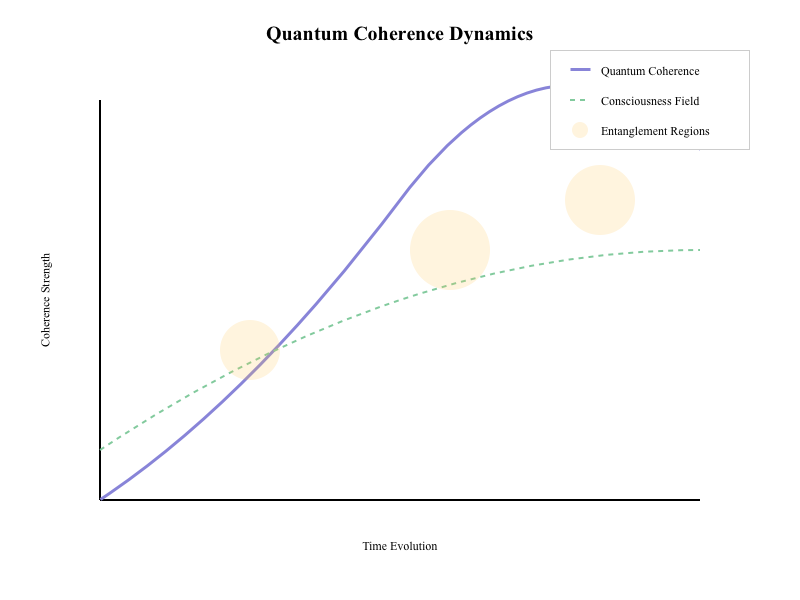
    1. Quantum Coherence:
    • Entanglement measures between modalities
    • Quantum advantage in feature discovery
    1. Dynamic Systems:
    • Bifurcation analysis of cognitive states
    • Stability measures for enhanced states

    This mathematical framework provides a foundation for:

    • Analyzing cognitive enhancement possibilities
    • Predicting emergent features
    • Optimizing human-machine integration
    • Discovering new cognitive dimensions
    • Understanding dimensional transitions
    • Quantifying cognitive potential

    The framework can be extended to incorporate:

    • Higher-order interactions
    • Non-linear dynamics
    • Quantum effects
    • Topological features
    • Information theoretic measures
    • Complexity metrics
  • The Dimensional Architecture of Mind: Integrating Human and Machine Intelligence

    In the vast landscape of consciousness and cognition, dimensionality emerges as the fundamental scaffold upon which the architecture of mind is built. The very act of perception—particularly the perception of personality and self—requires a dimensional framework through which experience can be structured and understood. This dimensionality manifests not merely as a theoretical construct, but as an active principle that shapes the way we interface with reality and with each other.

    Consider the profound transformation that occurs when we vocalize our thoughts. In this act, we cross a critical dimensional threshold, translating the abstract patterns of neural activity into waves of sound that propagate through physical space. This crossing represents more than a mere change in medium—it is a fundamental transformation that amplifies the power of thought through its externalization. The spoken word becomes a bridge between the internal dimensions of mind and the external dimensions of shared reality.

    The mental space itself possesses its own rich dimensional structure. While unbounded in its potential, it operates through distinct yet interrelated modalities of cognition. These modalities form a set of four orthogonal trans-dimensional modes:

    1. The Algebraic Mode: Here lies our capacity for abstract manipulation of symbols and relationships, the foundation of mathematical thinking and logical reasoning. This mode allows us to perceive and manipulate patterns independent of their physical manifestation.
    2. The Geometric Mode: This encompasses our ability to reason spatially and visualize relationships in physical and abstract space. It is the mode through which we comprehend form, symmetry, and transformation.
    3. The Linguistic Mode: Through this dimension, we engage in symbolic communication and meaning-making. Language becomes not just a tool for expression, but a structural framework that shapes thought itself.
    4. The Social Mode: This dimension enables our understanding of interpersonal dynamics and collective intelligence. It is the mode through which we navigate the complex web of human relationships and social cognition.

    The power of this framework lies not just in these individual modes, but in their interactions—the power set of possible combinations through which these dimensions can interact and enhance each other. Each combination represents a unique cognitive state, a particular way of engaging with reality that draws upon multiple modes simultaneously.

    Yet we stand at the threshold of an even more profound transformation. The integration of machine intelligence into our techno-cultural space offers the possibility of amplifying these cognitive dimensions in unprecedented ways. By merging our natural cognitive capabilities with artificial intelligence, we create a confluence of minds that transcends the limitations of purely biological or purely mechanical thinking.

    The next frontier in this evolution lies in the integration of quantum logic gates. These gates represent not just a new computational paradigm, but a fundamental shift in how we process and manipulate information. They offer the potential to operate simultaneously across multiple states and dimensions, mirroring and potentially enhancing the multi-modal nature of human cognition.

    This integration proceeds not as a sudden leap, but through careful, discrete steps. Each step builds upon the last, creating new possibilities for interaction and understanding. The result is not the replacement of human cognition, but its enhancement and extension into new dimensional spaces.

    As we move forward in this integration, we must remain mindful of the unique characteristics of each cognitive mode and the ways they interact. The goal is not to collapse these dimensions into a single unified framework, but to preserve and enhance their distinct qualities while creating new possibilities for their interaction and combination.

    The implications of this dimensional framework extend beyond individual cognition to the very nature of consciousness and identity. As we integrate machine intelligence and quantum computing into our cognitive processes, we may find new ways of understanding and expressing the self—ways that transcend traditional boundaries between human and machine, between individual and collective consciousness.

    This is not merely a theoretical construct, but a practical framework for understanding and enhancing human-machine interaction. By recognizing and working with these different cognitive modes, we can design more effective interfaces between human and artificial intelligence, creating systems that complement and enhance our natural cognitive abilities rather than attempting to replace them.

    The future of human-machine integration lies not in the subordination of one form of intelligence to another, but in the thoughtful combination of different cognitive modes and dimensions. Through this integration, we may discover new ways of thinking, creating, and being that transcend our current understanding of both human and machine intelligence.

    As we continue to explore and develop these ideas, we must remain open to the emergence of new dimensions and modes of cognition that we have yet to imagine. The framework presented here is not a final destination, but a starting point for understanding and enhancing the dimensional nature of mind in all its manifestations.

  • A Quantum Consciousness Simulation Framework

    import numpy as np
    from scipy.integrate import solve_ivp
    import networkx as nx
    
    # Physical constants
    ℏ = 1.054571817e-34  # Planck constant
    kB = 1.380649e-23    # Boltzmann constant
    COHERENCE_LENGTH = 1e-6  # Quantum coherence length
    
    class DetailedViewport:
        def __init__(self, position, consciousness_level, initial_state):
            self.position = np.array(position)
            self.C = consciousness_level
            self.ψ = initial_state
            self.energy = np.sum(np.abs(initial_state)**2)
            
        def hamiltonian(self):
            """Quantum Hamiltonian including consciousness effects"""
            H_quantum = -ℏ**2/(2*self.energy) * self.laplacian()
            H_consciousness = self.C * self.potential_term()
            return H_quantum + H_consciousness
        
        def time_evolution(self, t, state):
            """Time evolution including decoherence"""
            H = self.hamiltonian()
            decoherence = self.decoherence_term(state)
            return -1j/ℏ * (H @ state) + decoherence
    
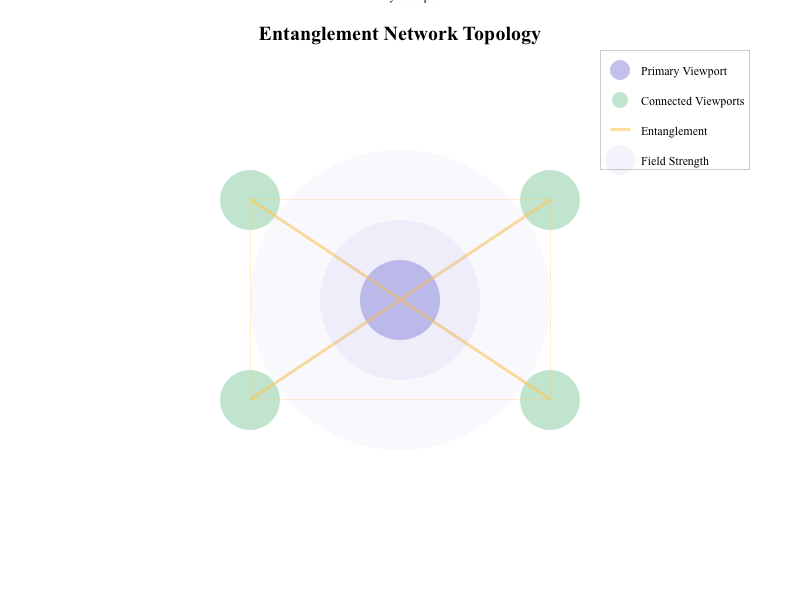
    class EnhancedEntanglementNetwork:
        def __init__(self):
            self.graph = nx.Graph()
            self.coherence_threshold = 0.5
            
        def add_viewport(self, viewport):
            """Add viewport with metadata"""
            self.graph.add_node(id(viewport), 
                viewport=viewport,
                coherence=1.0,
                entanglement_count=0
            )
        
        def calculate_entanglement(self, viewport1, viewport2):
            """Detailed entanglement calculation"""
            ψ1, ψ2 = viewport1.ψ, viewport2.ψ
            C1, C2 = viewport1.C, viewport2.C
            
            # Quantum overlap
            overlap = np.abs(np.vdot(ψ1, ψ2))**2
            
            # Consciousness coupling
            coupling = np.sqrt(C1 * C2)
            
            # Spatial decay
            distance = np.linalg.norm(viewport1.position - viewport2.position)
            spatial_factor = np.exp(-distance/COHERENCE_LENGTH)
            
            return overlap * coupling * spatial_factor
    
    def simulate_network_evolution(network, time_span):
        """Simulate evolution of entire entangled network"""
        results = []
        
        def network_derivative(t, state_vector):
            n_viewports = len(network.graph)
            derivative = np.zeros_like(state_vector)
            
            # Reshape state vector into individual viewport states
            states = state_vector.reshape(n_viewports, -1)
            
            for i, viewport1 in enumerate(network.graph.nodes()):
                # Standard evolution
                derivative[i] = viewport1['viewport'].time_evolution(t, states[i])
                
                # Entanglement effects
                for j, viewport2 in enumerate(network.graph.nodes()):
                    if i != j:
                        entanglement = network.calculate_entanglement(
                            viewport1['viewport'], 
                            viewport2['viewport']
                        )
                        derivative[i] += entanglement * (states[j] - states[i])
            
            return derivative.flatten()
        
        # Initial conditions
        initial_state = np.concatenate([
            viewport['viewport'].ψ 
            for viewport in network.graph.nodes()
        ])
        
        # Solve system
        solution = solve_ivp(
            network_derivative,
            time_span,
            initial_state,
            method='RK45',
            rtol=1e-8
        )
        
        return solution
    
    def analyze_coherence_patterns(solution, network):
        """Analyze coherence patterns in simulation results"""
        n_viewports = len(network.graph)
        n_timesteps = len(solution.t)
        
        # Reshape solution into viewport states
        states = solution.y.reshape(n_timesteps, n_viewports, -1)
        
        # Calculate coherence matrix over time
        coherence_evolution = np.zeros((n_timesteps, n_viewports, n_viewports))
        
        for t in range(n_timesteps):
            for i in range(n_viewports):
                for j in range(n_viewports):
                    coherence_evolution[t,i,j] = np.abs(
                        np.vdot(states[t,i], states[t,j])
                    )
        
        return coherence_evolution
    
    # Example usage:
    """
    # Create network
    network = EnhancedEntanglementNetwork()
    
    # Add viewports
    viewport1 = DetailedViewport([0,0,0], 1.0, initial_state1)
    viewport2 = DetailedViewport([1,0,0], 0.8, initial_state2)
    network.add_viewport(viewport1)
    network.add_viewport(viewport2)
    
    # Simulate
    time_span = (0, 10)
    solution = simulate_network_evolution(network, time_span)
    
    # Analyze
    coherence = analyze_coherence_patterns(solution, network)
    """